Shining Beacons of Light

Shining Beacons of Light

Sunday, April 20, 2014

"Do not be afraid": A Sermon for Easter Day

In the name of the risen Christ. Amen.

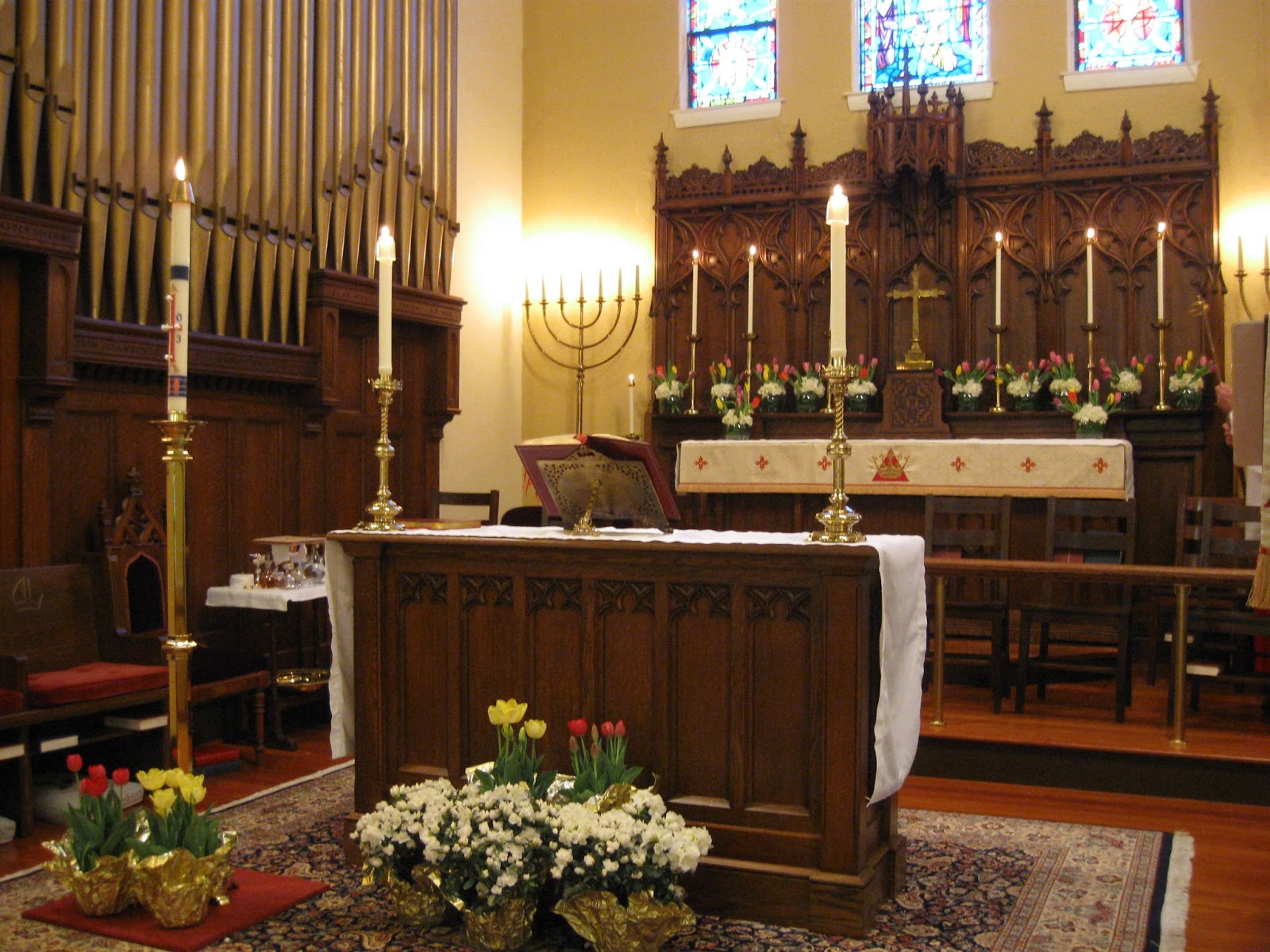
What a pleasure and delight it is to share this bright (if rather brisk) Easter morning with you. It is a pleasure to see the church looking so Eastery (thanks to our hard-working altar guild), to hear us sounding so Eastery (thanks to our talented and also hard-working choir). Most especially, it is a pleasure and delight to see this place so full and to see you, some parishioners I know well, some families visiting from a distance, and also to see those of you who may be here at Emmanuel for the very first time, or at least for your first Easter. Easter really is when we are at our best—though we’re pretty good the rest of the time, too.

I think maybe we have such a particular fondness for Easter here at Emmanuel because our very first service as a parish was on an Easter morning, all the way back in 1870—some 144 years ago. So, every Easter is our birthday or anniversary in a way. Now, I don’t think any of you here this morning have been coming to us quite that long, since 1870, but whether this is your 90th Easter at Emmanuel or your very first, I want you to know that you are very welcome here, and that we would be more than delighted to have you consider this parish your church home. I’m quite positive that those who are familiar with our community, whether longer term members or newer, would attest that this is a warm, welcoming and inclusive congregation. We are made of up people of every background and perspective, all united in our love of God and in our desire to share that love, that Easter, resurrection love, with each other and with the wider community.

You know, something I often find myself reflecting on, especially on days like Easter, days when we remember back to long ago stories and sacred traditions, is how much we, today, in the year 2014, are just like the people we read about in the Bible. Here we are, separated by thousands of years in different contexts, and yet our desires, inclinations, and thoughts are almost exactly the same. Sure, we have cars and the Internet and smart phones, but who we are deep down, who we are as human beings is exactly the same. Like Peter and Paul, like John and James, and Mary Magdalene and Mary Jesus’ mother, we have families and many of us have jobs (or have had, or will have). We worry about our future and our kids’ futures and we care for aging parents, some of us have wonderfully fulfilling personal relationships, while others of us too often feel alone and have what seem to be more than our fair share of struggles. Like people in ages past we also get sick and desire healing. We long for understanding, we long for hope, we long for a sign, some sign, that things will turn out right for us and for those dearest to us. Whether we use the words or not, we long for God.

I suspect that more than anything else, it was this longing, this deep inward longing for healing, and understanding, for hope and for God, that first drew people to Jesus, so long ago. Whatever Jesus looked like, whatever he sounded like, whatever his personality was like—there was something about him, some great spark or fire in his soul, perhaps—that had the power to draw people in. Just being with him, or being touched by him, made people, of any background, feel whole, accepted, alive, and real even. It must have been so extraordinary. And probably, it was not really like anything that we can even begin imagine now, so many years later.

And then, suddenly, in a flash, on that Friday, he was gone. Although we know that it happened  (all four gospels tell us so), that too is really beyond our imagining and our understanding. We know that most of those who had followed Jesus, those who had been touched and healed by him, those who had been taught and fed, fled and went into hiding during and after the crucifixion. Some, like Peter, even denied that they had known Jesus. Whatever healing, whether physical or spiritual, whatever new and abundant life he had given them was suddenly gone, overtaken by grief, and also by fear. Perhaps fear that they might be next. Or maybe even fear that everything they had come to believe so powerfully was really all just a big lie. Maybe Jesus wasn’t so close to God after all. Maybe it was all just wrong. So, what did they do? They locked themselves away. They wouldn’t even answer a knock on the door, they were so afraid.

Fear really is hard to overcome, isn’t it? It is so immobilizing. Whether the object of our fear is real or imaginary, whether it’s concern about a medical diagnosis, or a sudden 2:00 a.m. panic about work or bills, or even if it’s a monster under the bed or a ghost in the closet that we are afraid of, fear can often become so consuming that it is impossible to even move. Like Jesus’ disciples on Good Friday and the days following, at times like that, when we are afraid, locking ourselves away in a secret room may seem like the only reasonable and safe solution. But, of course, it doesn’t really help. Not really. In fact, it probably just makes it worse. Because then, we let our fear direct our lives. We allow it to have power over us, which is just what it wants.

I remember having an inkling of that kind of fear back on September 11, 2001. I had just started working for Episcopal City Mission at the diocesan offices in Boston. After the first plane hit the World Trade Center, most of the staff went up to Bishop Shaw’s office to watch the news, as he had the only TV. After the horror of it all became clear, there was a Eucharist and prayer service in the cathedral, led by Bishop Barbara Harris, and then the bishops closed the offices at about noon. I lived in Jamaica Plain and the only to get home was on the subway. I remember thinking that we probably were safer at the cathedral than on public transportation, but of course I had to go. That ride home was the quietest, eeriest and most surreal I ever remember. Once I got to my apartment, I felt a lot like Jesus’ disciples on Good Friday. I just wanted to lock the door and never go outside again.

Similar feelings were rekindled the week of the Marathon bombing a year ago, especially, for me, on that surreal Friday, when Boston, Cambridge, and Watertown were all in lockdown. Do you remember how every TV station was endlessly just showing live shots of tanks and SWAT teams going from door to door to door, knocking and searching, knocking and searching. I live in Quincy, not in the lockdown area, but close to it, and I, too, was hesitant, apprehensive, about being outside. I did go out some, for lunch and a walk. It was actually a beautiful spring day, as I recall, but the only sounds outside I remember hearing were birds chirping and police sirens echoing through the air.

Fear—whether justified or imaginary—can be, and often is immobilizing. It is so consuming, and limiting, and un-empowering. Fear prevents us from believing, from seeing, from hoping and working and striving for something better. In fact, fear is contrary to everything that Jesus taught and did and lived, each and every day of his life and ministry. It is contrary to the life—the abundant life—he so desires for us.

Which, as it happens, is exactly why we have Easter and the resurrection. More than anything, what the resurrection does, what Easter does, is cast out fear. Or maybe, it’s better to say that the resurrection gives us the courage we need so that we can cast out our own fear, so that we can overcome it. The resurrection is God’s reminder to us, God’s promise really, that no matter what may happen in life, no matter what broken or messed up situation we may find ourselves in, whether of our own making, or something beyond our control, it is not so broken and it is not so messed up that God can’t somehow find a way to redeem it and bring new possibilities into being. Sometimes it may take a while—it won’t always be just three short days, and it won’t always be the way we first envision—but eventually, somehow, new life will spring up: new life, new hope, and a new way. The stories we’ve been hearing lately about the Marathon bombing victims, a year later, are testament to that fact—some who lost legs are dancing, others are getting married or expecting children. Easter promises us that God can take any broken, messed up, rotten situation, and make it new. Not unaffected by the past, not as if it didn’t happen, but renewed and filled with fresh possibilities.

As it happens, that’s what Mary Magdalene and the other Mary discovered on the first Easter morning, along with the empty tomb. Undoubtedly, when they set out early that day their grief was overwhelming, and probably their fear, too. They likely wondered and worried about what was coming next; probably they were fearful about what would become of them without Jesus; they may even have wondered if they could have or should have done or said something differently along the way. Who knows, maybe if they had, Jesus would still be alive, still with them, still teaching and healing, still loving and still being loved.

Of course, as it turns out, as we know, Jesus was still alive, or least, he was alive again, however it happened, beyond their and our explanation and imagining. And do you remember what were his very first words to women when he met them on the road, after greeting them? He said: “Do not be afraid.” Do not be afraid. Just like the angels at the empty tomb, just like the angels announcing Jesus’ birth to the shepherds in their fields, and just like the Gabriel visiting Mary and telling her she would bear God’s Son. These words, God’s words, spoken to them, spoken to us, spoken for 2000 years, are always the same: “Do not be afraid.”

The resurrection is God’s way, God’s miraculous, mind-boggling, rule-twisting, world upside-down-turning way, of giving us the strength and courage that we need to overcome our fears, to unlock our doors, and to roll away the stones, so that we can step out of our tombs and away from our fears, so that we can walk confidently into the bright sunlight of Easter morning, able once again to live, fully, and freely, and abundantly.

That’s what this resurrection Easter feast is about. Easter, the resurrection, isn’t only something nice that God did for Jesus, long ago. It is for you, and for us all: whoever we are, whatever our backgrounds, whatever our mistakes, whatever our hopes and whatever our fears. Easter promises us all a new day. And it promises us a new chance for a new kind of life, a resurrected kind of life. That life, that resurrected, fear-free life, is God’s Easter gift to you, on this beautiful spring morning, and always.

Just as he greeted the women long ago with these words, so also does the resurrected Jesus greet each of us with the same words and with the same Easter message: “Do not be afraid.”

Alleluia. Christ is Risen. Happy Easter.


© The Rev. Matthew P. Cadwell, Ph.D.

Tuesday, April 15, 2014

Focus on Faith: A Reflection for Passover and Holy Week

Over the course of this week, Jewish and Christian people of faith will be observing some of our most sacred traditions. For Jews, it is the time of Passover (Pesach), commemorating God’s deliverance of the Hebrew slaves from bondage in Egypt under the Pharaohs. Passover is a weeklong observance (this year from the evening of Monday, April 14 to sundown on Tuesday, April 22). It includes the ritual cleansing of the home, reading of the story of the Exodus, singing, games, and a special dinner with family and friends called a “Seder,” usually held on the first two nights of the holiday.

The Seder meal is both solemn and celebratory, recalling the Israelites’ bondage and strife, as well as their deliverance into freedom under Moses. Not being Jewish myself, I had always assumed (based primarily on my childhood viewing the Ten Commandments with Charleton Heston) that the Passover observances were somber. I learned otherwise when I was invited to a Seder at the home of some Jewish friends when I lived in Canada. There are serious elements, but for the most part it is a joyful celebration, in thanksgiving for God’s goodness. In fact, my hostess told me that she wouldn’t have done her job until I was so stuffed that they would have to roll me out in a wheel barrel. It was just about necessary.

Christians are in the midst of Holy Week. It begins with the remembrance of Jesus’ triumphal entry into Jerusalem on Palm Sunday and concludes with the celebration of Easter. In between these two high points are plenty of lows, including the recalling of Jesus’ Last Supper with his disciples, his betrayal, arrest, and finally his crucifixion under the Roman governor Pontius Pilate on Good Friday. It is believed by Christians that these events occurred during the week of Passover and that Jesus (who was Jewish) was in Jerusalem to observe the holiday.

There are multiple theories and doctrines that attempt to explain why Jesus was crucified (executed as a criminal, in fact), what his death meant nearly 2000 years ago, and what it continues to mean today. In the Roman Empire crucifixion, being the most painful and humiliating punishment conceivable, was reserved for treasonous enemies of the state. So, it likely was a result of claims made (by Jesus, by his followers, or by his enemies) that he was the King of the Jews and the Son of God. In the Roman Empire, only Caesar would have been afforded such lofty titles. Whatever the reasons, we should never lose sight of the fact that Jesus and his disciples were Jewish themselves, even if his teachings challenged the religious standards of his day. The gospels’ attempts to paint the Jewish populace as the “bad guys” in the story of Jesus’ death likely reflect a later prejudice among minority Christians. It is a perspective that has haunted Western civilization ever since and needs to be confronted. It was the Empire that killed Jesus, evidenced by the fact that he was crucified as an enemy of the state.

Most importantly, Christians believe that on the Sunday after his death Jesus rose again. We don’t know and can’t explain how, beyond believing that God is always more powerful than we can imagine. This is what we celebrate on Easter. It is the faith that has sustained Christians for 2000 years. Just as our Jewish brothers and sisters believe that God was powerful and faithful enough to free the Israelites from their bondage in Egypt, Christians believe that the powers of evil and death were not strong enough to hold or defeat Jesus. For Christians, the resurrection is God’s promise and demonstration to all people that sin, evil, despair and even death cannot and will not have the final word in human life.

So it is that Jewish and Christian individuals, families, and faith communities across the world are simultaneously remembering and celebrating the great promises and actions of God this week. They are promises of hope. They are promises of liberation. They are promises of life—new and abundant life. The Wakefield Interfaith Clergy Association invites you to join one of our faith communities this week and experience that abundant new life for yourself.


© The Rev. Matthew P. Cadwell, Ph.D.

Sunday, March 30, 2014

On Dusty Springfield, the Pet Shop Boys, and the Miracle of Sight: A Sermon for Laetare Sunday

This past Wednesday evening, during our Bible study, I mentioned in passing the 1960s Dusty Springfield song “Wishin’ and Hopin.” I guess in doing so I surprised the Wednesday crowd, as they wondered how I would even know about this song, since Dusty, great as she was, was not exactly at the height of her popularity for my generation in the ‘80s, which was more the Madonna era. But I love Dusty even so, and listen to her lots, especially when I’m working around the house. Though, not while writing sermons—I tried that in preparation for Ash Wednesday this year and it was a total disaster. I was too busy singing.

Now, like the Wednesday night crowd you, too, might be wondering how I would even know about the great Dusty Springfield—with her big blonde beehive hair, thick mascara, and soulful voice. Well, for starters, it’s because when I was about 14 my new and (as it happens) my still favorite band was the English electronic synth dance duo—the Pet Shop Boys. And in 1987, just as I discovered them, they released a duet with Dusty titled “What have I done to deserve this?,” which ended up being her biggest ever hit, and introduced her to a whole new generation of fans, just like me. But, as much as that was my official, conscious introduction, as I think on it, it’s probably also the case that I like her because my father, a child of the 60s, absolutely loved that era’s music, especially of the “British Invasion.”

And Dusty, well, she was the undisputed female Red Coat General of the British Invasion, reaching these shores even before the Beatles and breaking new ground with her “blue-eyed soul” Motown sound, with hits like “I only want to be with you,” “Wishin’ and Hopin’,” “Just don’t know what to do with myself,” and later “the Look of Love” and “Son of a Preacher Man.” On car trips or just hanging around the house, that’s what I heard, along with the likes of the Beatles, Gerry and the Pacemakers, and for a little American flavor, Peter, Paul, and Mary.

My dad literally spent hours and hours on Saturday afternoons sitting on the living floor, with his meticulously cared for 1960s records piled up all around him (I was never allowed to touch them), putting together the perfect 8-track mixed tape for long driving trips through Canada and the Black Hills, for work (he was a courier, so he spent considerable time in the car), or just for Saturdays at home. You may know that he died when I was 15, and he was just 38, so his beloved ‘60s music is one of the ways that I have of holding on to him, feeling that’s he present still. Though, I have to admit that my favorite song, perhaps of all time, is still, and maybe forever will be, the more contemporary Dusty, with the Pet Shop Boys, singing in very techno fashion: “What have, what have I, what have I done to deserve this?”


As it happens, “What have I done to deserve this?” is a question that people ask all the time. What have I done to deserve being sick? What have I done to deserve being fired from my job? What have I done to deserve having my spouse or partner leave me, or worse, die unexpectedly? No doubt the family members of those lost in the missing Malaysian airplane, those affected by Washington mudslide, survivors of the firefighters in Boston or the Marathon Bombing, of 9/11, Pearl Harbor, or even Nagasaki and Hiroshima, could all ask the very same question: what have I done to deserve this? I suppose it’s a question that my mom, my brothers, and I all could have (and might have) asked when my father died unexpectedly 26 years ago, too. It’s even one that my dad himself might have asked, since from the time he was in his late 20s he struggled with the effects of muscular dystrophy, having to wear leg braces and often struggling to walk, which is probably what led to him falling in an accident, breaking his knee, and dying after surgery.

Unfortunately, though, who ever we are, and whatever our personal afflictions or struggles, whatever our grief or loss, the “what have I done to deserve this?” question often ends up going unanswered, because, really, most times, there simply is no good or satisfactory answer. Things just happen. Painful things. Undeserved things. Things that make no reasonable or rational sense.

But, because we human beings don’t really like unanswered questions, we make up explanations. For example, whatever bad thing might have happened—whether on a small personal scale or in bigger more universal ways—it is all part of God’s mysterious plan. For centuries people have thought that way, for millennia really, probably going back to the very origins of humanity. If there’s something we don’t understand or can’t make sense of, well, then, we can blame it on God. Or if not exactly blaming it on God, then blaming it on ourselves (or on other people’s selves), followed by what we deem to be God’s appropriate judgment. That’s the whole point of the biblical Book of Job, after all--why do bad things happen? It is God's fault? Our fault?

And sometimes that can be comforting, in a way. Having the faith that God is always in charge and that whatever happens, seemingly good or bad, it is by God’s design. But at other times, that can seem really, even outrageously offensive, too. Did God have a hand in causing 9/11 or the Holocaust, or less globally, taking my dad from me, or your loved ones from you? I don't know for certain, but I just don’t think God does that. I don’t think that God wants us to go through grief or pain or loss, all to fulfill a great master plan. I suppose it’s possible. But it’s not really how the God I believe in operates.

But what God does do, I think, is help us endure these sufferings. God stands with us and dries our eyes. God helps us to see that there is a new day on the horizon, holding out the promise of new opportunities, new hope, and new life. God helps us to know that as we suffer and endure trials, losses and hardships, we are never alone. Because God, and the Great Cloud of Witnesses —the Mystical Body of Christ, the blessed company of all faithful people, as we pray in the Rite I post-communion prayer—are always there with us, alongside us, and even within us, propping us up, prodding us along, and giving us eyes, opened eyes, to see the world and our lives in it in ever new ways.

That, at least in part, is what I think our gospel passage this morning is all about. Here we find a man who is blind from birth, who has never seen anything, at least physically. But through Jesus’ presence and intervention he finds himself healed. He is given new sight. And more importantly, he is given new understanding—of himself, of his faith, and of the power of God. (You’ll notice in the passage that he goes from saying Jesus is a man, to saying he’s a prophet, to finally saying that he’s the Son of Man, the Messiah).

If you remember, one of the questions that people around him had been asking, probably since the time he was born, was what had he done to deserve this, this blindness? Or, if it’s not his fault, what had his parents done? Because no one would be born blind otherwise. It must be a symptom of some other greater, deeper, more profound, inner evil. In fact, the blind man probably believed this himself—that his condition was a direct consequence of his own inner sinful nature.

But then, along comes Jesus. And he tells the blind man, his own disciples, those crabby, wet blanket Pharisees, and us 2000 years later, that this just is not so. By giving the blind man sight, by opening his eyes, Jesus testifies that his blindness is not some kind of punishment from God, but is instead a condition that we all share, in various ways, by virtue of being alive. We are all limited in some way or another—for some it is sight, for others hearing, for still others it’s not so much physical, but feeling alone or discouraged, unsatisfied or unfulfilled. None of this is God’s punishment for anything that we, or certainly our parents have done. Nor is it even necessarily punishment for what Adam and Eve did in the Garden of Eden at the beginning of time.

Instead, it is simply a manifestation of being human, of being limited, fragile, mortal. But Jesus tells us, in fact, he shows us, that through him, by being united to him, we can transcend these limitations and truly see, truly hear, and truly be filled. Whatever our griefs, whatever our losses, whatever our crucifixions and Good Fridays, we will always find Easter and we will always be led to resurrection. Which is, of course, the whole point of our Christian faith. We haven’t done anything to deserve it, this resurrection, to answer the question of my favorite song. But it’s what we get. Just because. Christ shines upon us light to see and know that even in our grief, even in our loss, and even in our limitations, we are never alone, we are never truly blind, and, most importantly, we are never really dead.

As it happens, that was exactly my experience, so many years ago, when my dad died. Not at first, of course. At first it was horrible. But over time I came to believe that God had not abandoned me or my family, but was walking alongside us and strengthening us, propping us up and giving us hope. Through that experience, our faith—or at least mine—grew deeper and stronger and more real. Not because it gave me any answers as to why. But because, through that grief, I experienced the promise of resurrection and new life in a profoundly real way. It wasn’t any longer just something I was taught to believe in at Sunday School or confirmation class. Rather, it became something that touched me at the heart of who I am. In fact, I’d even say that’s why I am here as a priest among you today. My feeling of being loved, being cared for, and being filled with Christ’s light at that painful time—through friends, through our church community, and through prayer—through Mystical Body of Christ, the blessed company of all faithful people—was so powerful, so encompassing, so motivating, that I felt called to share it with others, even if all too often dimly and imperfectly.

That’s how God works—God takes people, people like his Son Jesus, people like Jesus’ disciples, people like us, even people like the wet blanket Pharisees, and he uses them. God uses us all, in our various gifts and in our various limitations, to make the world brighter, fuller, and more alive. So that others, too, can see. And then, so that they can believe.

To God be the glory: Father, Son, and Holy Spirit. Amen. 


© The Rev. Matthew P. Cadwell, Ph.D.

Wednesday, March 12, 2014

On Temptations, Wildernesses, and Journeying to God: A Sermon for the First Sunday in Lent

So, it’s the first Sunday of Lent and I have to confess that so far, anyway, I haven’t had a very Lenten Lent. On Thursday, the day after Ash Wednesday, I had a couple glasses of wine. On Friday, I ate French fries, and yesterday, Saturday, I ate a piece of black forest cake. Every day I’ve drunk coffee, as well as my biggest temptation—Diet Cherry Dr. Pepper—well maybe I’ve had a little less of that, but not considerably.  If Lent is supposed to be about giving things up, about denying ourselves things we like, little pleasures like French fries, Black Forest cake or Dr Pepper—well, then, I am a miserable failure. Of course, the good news is that there’s still over a month to go, so maybe I can pick myself up, dust myself off, and start over again. Maybe.

But it’s so hard sometimes. Especially when we have gorgeous spring-like days like yesterday. Under those conditions it’s hard to focus on fasting and self-denial when outside it feels a lot more like Easter, a lot more like resurrection and new life. That’s the trouble with Lent beginning as late as it does this year. In other years, Lent starts in mid-February, when its cold and dark and we already feel a little morose. It’s just not fair for it to start when, after a long and torturous winter, we are already eagerly anticipating the new life of spring. So, I am perfectly comfortable blaming my Lenten failures on the calendar. It really won’t care.

Plus, the really good news is that Lent is actually about a whole lot more than giving up wine or chocolate or fried potato products. It’s really about journeying deeper into the heart and being of God. It’s about letting go of whatever doesn’t matter, whatever clutters up our lives, so that we can focus on the things that really do matter—who we are, who God made us to be, who God hopes for us to become.

That’s what I think I would like to focus on this Lent, in both my prayer and in my living: discovering who I am in Christ and who God wants me to be. And I would invite and encourage you to do the same: focus on who God made you to be and who God wants you to become. Those of you who were here on Ash Wednesday this past week will remember that I spoke about the stark dichotomy between the dark symbol of the ashes—a sign and reminder of our mortality—and our society that seems so intent on denying or even somehow trying to overcome that mortality, whether through exercise or diet, medicines, face creams, or more dramatically with the very pleasant and breezy sounding “lifestyle lift,” which is probably not all that pleasant or breezy in reality. All are meant, in a way, to help us defy the odds and live forever—or at least look like we are 20 years younger when the time of our mortality finally comes.

Now, as I said on Wednesday, there’s certainly nothing wrong and a lot right with being healthy. And really, there’s nothing wrong with looking young or younger than your years either. After a certain age we all desire that. But what is problematic, I think, is when the attainment of a perfect body or the perfect job or the most stunningly gorgeous spouse or partner becomes so absorbing that we lose sight of who are, and whose we are. The cross of ashes on our foreheads and the reminder that we are dust and to dust we shall return serves, I think, in a very powerful way, to draw us, or even jolt us, back to our center in God. Through the ashes, through the cross, we are reminded, yet again, that none of this external stuff, none of the stuff or the promises that are advertised on TV, radio, or the Internet really matters. Because it won’t last. Like our mortal bodies, one day all that stuff will also again be dust. It will return to the source from which it came: God. And so will we.

I think, really, that’s the meaning in the wilderness temptation story that we just heard in today’s gospel. Much like the voices speaking to us through our TVs, radios, and computers, telling us that if we only sign up or show up, take a pill or pay three easy installments of $29.99, we can be skinnier, prettier, younger, richer, have a better partner, a better house or a better car, much like those voices Satan tries in various ways to lure Jesus away from his true self and center in God by suggesting that if he just turned some stones into bread he wouldn’t be hungry any longer, or if he’d bow down (in other words, turn to Satan and away from God) he’d have all the power he could possibly want or need. Jesus doesn’t give in, as we know, but we shouldn’t imagine that it wasn’t hard all the same—after all, after 40 days he probably was really hungry. And who wouldn’t be drawn in by the promise of wealth or power or prestige?

And here’s the thing. Because we are good Christians and because we have been brought up to believe that Jesus lived sinlessly, we tend also, sometimes, to think that Jesus was so perfect, so beyond corruption or temptation, that nothing could or would have phased him, that these temptations just sort of rolled off his back. But I don’t think that’s right. Because Jesus was human. Fully, truly, really human. Human like you and me. And if these temptations weren’t really tempting, well then, who cares? It’s easy not to give into things you don’t like or want or need. What’s hard, what’s real, what’s miraculous even, is standing firm in the face of something that is truly alluring. That’s why, when we prepare to confront the power of temptation, we shouldn’t imagine that we will get a proper warning—like seeing a little red devil on our shoulders with horns and a pitch fork. Rather, it will be pleasant, reassuring, alluring and seductive even. It is for us, and I imagine that it was for Jesus, too.

In fact, if the Adam and Eve story in Genesis is to be believed, being tempted in this way, being tempted into thinking that we can be better or smarter, more attractive and more powerful, is something that humans have struggled with from the beginning of time. Only, also, as long ago as that, we humans have known, in a deep, inward, spiritual place, that by giving into these temptations, we end up losing part of ourselves, even as we also drift, little by little, and usually quite unintentionally, away from our center in God. We forget who we are and whose we are.

That, I think, is why the Adam and Eve story was written down in the first place—to try to help explain this weird inward pull we humans have for making choices that, for whatever reasons, seem to be good in the passion of the moment, but in retrospect are extraordinarily bad. In fact, when you stop to think about it, the whole of the Bible is full of such stories—people, good people, who are lured in by the promise of power, or prestige, or sensual pleasures, only to find that they have sold themselves or lost themselves to the highest (or even sometimes the lowest) bidder—Adam and Eve for a piece of fruit, Esau for a bowl of lentil stew, Samson, David, and Solomon for the lure of beautiful women.

But what we also learn, in reading the Bible, in encountering these stories of Adam and Eve, Jacob and Esau, Samson and Delilah, David and Bathsheba, Solomon and his 700 wives and 300 concubines (now there’s a biblical approach to marriage—how did he even have time for actually ruling Israel?), and so many more, what we learn through all of these stories is that although we may wander far off into wildernesses of our own making, God is steadfast, God is faithful, and God will always welcome us home again, welcome us home into God’s heart, where we were born and where we belong, forever and always.

And that, I think, is what this Lenten season is all about, more than giving up fried potatoes or black forest cake. It is the journey through temptations and out of our wildernesses. It is the journey back to God. And for Christians, for us here this morning, that journey comes with and in and through Christ. In following him, in striving to resist temptations the way he did, in taking up our own crosses, and even dying to the lure of power and prestige and beauty, dying to all of that, we will find that we are, in fact, truly alive. We find that we are able to rise again.

You know, on Wednesday, when we were marked with ash crosses and told that we are dust and to dust we shall return, we could just as well have been reminded that earlier, on another occasion, on another day, at our baptisms, after we were sprinkled or doused with water, we were likewise marked with crosses, on our foreheads—crosses that day not of ash, not of death and mortality, but of eternal life, life with and in God. And it is those crosses, the baptismal crosses, the resurrection crosses, that we are journeying to rediscover this Lent. So that when it really is Easter, when that glorious day comes, we will be ready and able to leave our wildernesses, our tombs, and rise with Christ.

To God be the glory: Father, Son, and Holy Spirit. Amen.

© The Rev. Matthew P. Cadwell, Ph.D.


Monday, February 10, 2014

On Salt, Light, and the Little Church on the Prairie: A Sermon for the Fifth Sunday after Epiphany

From time to time, over the past five and a half years, I’ve reflected in sermons on my conversion from the Lutheran church of my upbringing into the Episcopal Church, which I joined officially just about 20 years ago. It seems like a very long time ago now, about half my life, but at the time it was one of the hardest decisions I had ever come to. I know some of you who have come from other traditions have felt the same way, too—that you are somehow turning your back on all that was most important in your life for this new thing. Yet, there was something about the Episcopal Church and the Anglican tradition that had a special draw or lure for me, from the time that I first really learned of it while I was a college freshman.

Like most people, I already knew some of the less flattering stuff: Henry VIII, his divorces, beheading wives, naming himself the head of the Church in England, but I didn’t know any deeper details. When I finally learned more, beyond the scandalous tabloid-type history, in a college class called “Religion in America,” I was quite intrigued. In particular, I was attracted by my professor’s description of the Episcopal Church as being theologically open or even liberal, while maintaining a traditional, Catholic liturgical heritage. Before I had ever even stepped foot in an Episcopal parish I had come to the conclusion that it was the church for me. (My professor did also note, as something of an aside, that the Episcopalians never prospered out on the prairies or in the west, since they felt the need to carry so much heavy “stuff” with them—vestments, silver chalices, brass candlesticks, stained glass. Other traditions were lighter and more nimble, better suited to westward expansion, and thus ended up being bigger in the long run.)

My first visit to an Episcopal parish was to the Church of the Holy Communion in St. Peter, Minnesota, when I was a sophomore. I went with my friend Susan, who is Methodist but had attended before (plus, she had a car). I approached that visit with a sense of great anticipation, expecting there to be billowing clouds of incense and beautiful vestments, along with an erudite sermon filled with philosophical theology or something. That was what I was looking for at the age of 20. Only, it’s not quite what I found. Because, you see, the Episcopal parish in my college town is small. Smaller than Emmanuel—both in terms of the building, which probably seats about 100 people at most (we seat 150), and also in terms of the congregation.

The building, which is very nice, was constructed in 1869, 12 years before ours, of sandy-colored Kasota stone. It’s “A-framed,” with a very steep high peak, a small bell tower at the back, and the distinctive Episcopalian red front door. The first bishop of Minnesota, Henry Whipple, called it the prettiest rural or village church he had ever seen. Most were wood, so a stone church out on the frontier prairie must have seemed like a real extravagance. The town’s founder, a military captain, held the first service in his home in 1854, officiated at by the great western Missionary Bishop Jackson Kemper. The whole town attended—all 37 people. Captain Dodd eventually donated the land for the church and is buried behind it. The congregation today, 260 years later, if everyone is included, totals about 90 people, with an average attendance of 35. Of course, the city of St. Peter is only 11,000. So, as a percentage, Holy Communion’s membership and attendance are not too dissimilar from ours here in Wakefield, which is just a little more than twice as large at 24,000.

Well, instead of my dream church, with those billowing clouds of incense, what I found instead at the Church of the Holy Communion was a community of real people. A few of them were my college professors. There’s a philosophy professor I had who is very active in the parish, as well as a married couple, both Classics professors—one who taught Latin and the other Greek. The biggest surprise was that the Lutheran college chaplain’s wife was a member. I guess she didn’t feel the need to hear her husband’s sermons every week. And then there were people previously unknown to me, all kinds of people, really, from all kinds of backgrounds. They did not have a choir, but they had an organist whom I talked with a lot. What I remember especially about her is that she was first trained to play the accordion. They didn’t have Sunday bulletins either, just the readings insert. People looked up at the hymn boards for music (it was the first time I had ever seen hymn boards!) and they followed along in the Prayer Book, which was confusing to me at first, since the liturgy seemed to jump around a lot. If I remember correctly, after the service you had to walk outside and into a separate building for coffee hour.

And yet, despite its relative modesty, people kept (and keep) coming back. I did, too, off and on, until I graduated (though 9:30 service times weren’t always so attractive to this college student). There was something special, holy even, about that place, that community, which drew people in and gave sustenance and seasoning to life. The church and its people, to quote Jesus, were “the salt of the earth” and “the light to the world.” I suppose they weren’t the most “successful” by the standards of church growth, or prestige or anything like that. But, they were, and I assume still are, really wonderful. I just wish I had been less shy and more outgoing, so that I could have engaged that time and opportunity better. I wish I had let my light shine, to use Jesus’ imagery.

Today, I often think about the Church of the Holy Communion and how similar we are here at Emmanuel. It’s true that we’re somewhat bigger, in terms of congregation size, budget, even the building (though I do have very romantic feelings about that historic little church on the prairie, wishing it could be magically transported here, at least the outside. I’m very partial to our insides after all of the renovations we’ve done). But like them we are, by the standards that many of us have been used to from other denominations, also rather small. I hear that a lot from people—both long time parishioners and those who are new to us—that we are small.

What you may not know is that 68% of Episcopal congregations have fewer than 100 people in church on an average Sunday. 68%. In fact, the median average Sunday attendance across the Episcopal Church is 64 people, smaller than us by a fair margin when you add together our two services. We are just part of a denomination that, for a number of reasons, has favored smaller, more intimate parishes. I think it’s reflective of our English heritage, with little country churches in every town and village, rather than big mega churches that are more of a North American phenomenon. Of course, there are some big, impressive Episcopal churches, like Trinity in Copley Square, Epiphany in Winchester, or the National Cathedral in Washington. But they are not the norm. The norm, all across the country, are smaller, intimate, pastoral-sized parishes, parishes a lot like Emmanuel.

Maybe it’s because, as my college professor said, those early Episcopalians got too loaded down with “stuff” to do a good job of expanding. Or, maybe, it’s that our approach to faith and spirituality does not appeal to everyone. After all, not everyone likes smells and bells, let alone the ambiguity of unanswered questions in place of certainty. Even lots of Episcopalians don’t like those things. I suspect it also has to do with the fact that after a time there just weren’t so many immigrants to the U.S. who were Anglican. The English stopped coming very early on, replaced by Irish, Italians, Scandinavians, Germans, Poles, and now Latin Americans, Asians, and Middle Easterners, all who have brought other faith traditions.

But you know, whatever the reasons, size is not a measure of strength or effectiveness. Certainly it’s not a measure of depth of faith, as that little church on the prairie has made plain for 160 years. What matters is how we live our lives of discipleship. How we embrace our calling to be, as Jesus says, the salt of the earth and the light of the world. And that’s something that I think Episcopalians have been very good at: understanding that our numbers aren’t determinative for the impact we can have. That, too, along with the liturgy and theological openness, is part of what drew me to this church 20 years ago, joining that history, adding my voice to those in previous generations who have used their gifts and their lives to bring the kingdom of God that much closer—whether in fighting for civil rights on the streets or in court rooms, as an Episcopalian named Thurgood Marshall did for decades, or in serving dinner at Bread of Life in Malden this Thursday. In shattering the stained glass ceiling like Massachusetts’ own Bishop Barbara Harris, the first woman bishop of any tradition anywhere in the world, consecrated, as it happens, 25 years ago this week, or in striving to preserve the environment through Green Grants that are transforming our churches and helping us to leave a smaller imprint for the next generations. All are examples of adding salt and savor, light and new perspective.

What’s especially interesting, I think, is the fact that when Jesus uses the metaphors salt and light, he’s speaking of things that are small, but can have a big impact. Take salt: you don’t want to eat a dinner plate full of salt. Just a sprinkling is all you need to bring life to your food. And the same is true for light. When Jesus spoke, light was a rarer commodity than it is today. They didn’t have light bulbs or electricity and you couldn't just flip a switch. So, much more of life was spent in the dark. A single flame from a candle or oil lamp made all the difference between being able to see and utter darkness.

And that, Jesus tells us, is our calling as his disciples, as well: to add seasoning and taste, and to help others to see. We don’t need for everyone to become just like us. After all, no one wants to eat a bowl of salt. Instead, we need simply to cast enough light, and add enough savor to help others see and know God, as we have in our lives, but with their own eyes, in their own way. When we do that, we will have done our job and answered Jesus' call well. But, we have to do it. We have to add savor. We have to pierce the darkness, so that others can see. We can’t be so small, so limited, or so private that we don’t fulfill either our calling or our potential. In other words, our motivation, our drive, has to always lead us outward—to bring light and seasoning, glimpses of hope and peace, knowledge of God and the good news of God’s kingdom.

Part of that good news is that we don’t need to be especially big to do those things. After all, there were only 12 apostles at first. And we’re a lot more than 12 (often even at the 8:00 a.m. service). We just need to believe, really believe, that we are who Jesus says: “You are the salt of the earth… You are the light of the world…. No one after lighting a lamp puts it under the bushel basket, but on the lampstand, and it gives light to all in the house. In the same way, let your light shine before others, so that they may see your good works and give glory to your Father in heaven.”

To God be the glory: Father, Son, and Holy Spirit. Amen. 


© The Rev. Matthew P. Cadwell, Ph.D.

Sunday, April 21, 2013

On Terror, Hope, and Resurrection: A Sermon for the Fourth Sunday of Easter


Last Sunday morning, when we gathered here for worship, none of us could have imagined the week that would unfold before us.  Do you remember what you were thinking about then, last Sunday?  School vacation week maybe, or watching the Boston Marathon?  Finishing up your taxes, possibly a Monday off from work, maybe a spring clean-up of your yard, or even a trip somewhere? Taxes were certainly on my mind—I knew I owed some, but wasn’t sure how much and dreaded finding out for certain—plus I had a lot of concern that my second box of completed thesis copies, which I copied and sent the day before, would make it to Toronto without incident, unlike the first box that got waylaid along the way. (It did make it, by the way, on Wednesday as scheduled).  I was also thinking about meetings to come and pastoral concerns and who knows what else.  

Well, the two homemade bombs at the Marathon changed all that—for most of us in a less profound way, mainly—but for others far more permanently, as they lost people they love and as some were injured unbelievably.  Since Monday afternoon we’ve all been on an uninvited and unwelcome roller-coaster of emotion: shock and fear, then a degree of resolve, inspiration and hope, and then more shock, more fear, more anxiety, and finally, Friday night, some sense of relief. 

My mother called me on Saturday morning, saying that I must feel good that it’s all over.  And I do.  Or at least I feel relief that the two suspects can’t hurt anyone else.  But of course, it’s really not all over.  There’s so much that we don’t know and don’t understand yet, if ever.  Unfortunately, it may be quite some time before our many questions are answered, the most important of which is simply: “Why”?  Why would anyone want to disrupt something as joyful and innocuous as the Boston Marathon?  Why would anyone want to indiscriminately hurt and kill people he or she didn’t even know?  Why here?  Why now?  Just, why?

And then when the photos and the identity of the suspects were revealed, we might have wondered, too, and we might wonder still, why young men like those we presume did these horrible acts—with their futures ahead of them—would want to throw their own lives away for seemingly no reason, along with those they hurt and killed.  A few moments of attention is all they got out of all of this, and even that wasn’t so glamorous.  Certainly they didn’t become heroes of anything or anyone.  The younger brother, especially, seems to have really had a lot to live for: a graduate of the Cambridge Rindge & Latin School, with a college scholarship, recently made a U.S. citizen, lots of friends, great sense of humor, even a nice disposition.  But the older brother, too, about whom the deeper concern is centered, had some good things in his life, too—extraordinary talent as a boxer, also talent as a musician, a family that loved him, even it seems, a wife and a two-year old baby.  Why throw all of that away for nothing good?

Surely these brothers didn’t think they could just return to their normal lives on Tuesday morning, without notice, as if nothing had happened.  And the presence of several bombs and explosive devices in their apartment would suggest that they didn’t really expect to, either.  Or at least one of them didn’t.  Maybe over time we’ll get answers, at least partial, to some of these questions that still hang over us.  Though, we’ll probably never really, totally, know.  And we’ll never totally be the same as we were on Monday morning, either. 

But in the meantime, we go on with our lives, because we have to.  Not the same.  Not untouched.  Not unchanged.  But still moving along, moving ahead.  I thought about that on Thursday morning—before the extraordinary dramatic events of Friday—when I was in downtown Boston following an early budget meeting at the cathedral.  Usually after these things I just head home on the subway—diocesan budget meetings are exhausting, especially when they start at 8 a.m.  But Thursday was an especially beautiful day and I didn’t really have to be anywhere in particular for a while.  So, I walked leisurely through the Boston Common and then down Charles Street on Beacon Hill—one of my favorite streets in the city.  It was so gorgeous that bright spring morning.  In fact, it seemed even more gorgeous than ever.  Flowers were starting to bloom, birds were chirping, I paid special attention to the unique majesty of Beacon Hill’s architecture.  It all was like a special gift from God.  Like I was in the most beautiful city in the world, or if not the world, then certainly the United States.  I’m not sure Boston is quite as beautiful as Stockholm, but it’s close.

In fact, I was so inspired by the day that I had decided to spend a bucket load of money at a Scandinavian antique shop I had stepped into the week before, to buy something I wanted but really didn’t need, to heck with my shrinking checking account, and thankful to be alive and able to enjoy life in this gorgeous city and determined not to let terrorism stop me from doing what I wanted.  As it happens, though, the antique shop was fortuitously closed.  So, instead of spending a small fortune that morning, I enjoyed a much less expensive coffee and almond croissant at the cafĂ© next door—that seemed like an economical tradeoff.  And while I sat there, sipping my coffee, with a pretty tulip in a bid vase on the table, and looking out the window onto the bustle of Charles Street, I thought to myself, no bomb and no terrorist is strong enough to take any of that away from me, from us.  

Of course, that all was before the later drama of Thursday and Friday: President Obama’s visit and the inspiring Interfaith service, then the FBI’s release of the pictures of the suspects, followed just a few hours later by the murder of the MIT police officer, the carjacking, chase, horrible shootout in Watertown, and then the lockdown, manhunt, and finally capture.  I admit that some of that the joy, inspiration, and resolve I felt on Thursday morning on Charles Street was tempered again by a degree of anxiety and fear as I watched what was going on in Watertown, and I wasn’t even in the lockdown area.  Those of you up here in and around Wakefield were even further away from the nexus, but I imagine there was a good degree of anxiety here, too.  How could there not be?  I can’t begin to imagine what the people of Watertown must have been feeling through it all: hearing the gun fights, explosions, and opening their homes to SWAT Teams, to say nothing of the man who found the younger suspect in his boat.  The very thought of that discovery makes me absolutely ill. 

But even on Friday, as our doors were locked and we watched SWAT teams and armored trucks roar through city streets, streets we know and have visited, where friends and family live, we found ourselves struggling against fear and paralysis and struggling toward life.  I was heartened, in particular, by emails, text messages, phone calls, and Facebook posts from friends and family all over the country and the world, checking up on me, to see if I were okay.  I suspect that you had similar experiences of friends and family reaching out in love and concern.  I had wonderful, thoughtful messages from people I hadn’t heard from in a very long time.  Even in a time of stress, anxiety, and fear we find the hope of new life, abundant life, Easter life breaking through and breaking in.

Because, of course, that’s what Easter is all about.  It’s about hope that breaks into fear, joy that overcomes sadness, and life that is stronger and more powerful than death.  And that, surely, is what we have experienced here in Boston this week—hope, joy, and new life.  It doesn’t make the marks of the crucifixion go away—they never will totally go away—especially for those who lost limbs, or much worse, beloved family members and friends whose lives were torn away.  But even they, too, who were most affected by the bombings and the horrible aftermath will smile again—not because the suspects have been apprehended, that’s only a small part of it, as the families of the victims have said so eloquently and painfully—but because they have to, because we all have to, we all have to smile again, because God is always taking that which is dead and broken and transforming it into something new, something hopeful, something alive.  Because God is always taking us and transforming us.  Because God is always taking every day turning it into Easter.

You know, just as the people of Watertown, Boston, and Cambridge were in their locked homes this past Friday, on the very first Easter morning some 2,000 years ago, after Jesus’ crucifixion, the disciples, too, were locked away, afraid that the authorities would come after them.  They feared any knock on the door.  They feared that they would be next.  The world as they knew it seemed to be crumbling around them, turning to madness.  Of course they were even more isolated, since they didn’t have TV, Internet, Facebook or Twitter to keep them updated on what was happening outside.  But even so, into their fear, into their locked rooms and into their locked hearts, the resurrected Christ appeared.  He said to them “Peace be with you.” He said, “Do not doubt, but believe.”  And he said, “I am the Good Shepherd.  I love you.  I’ll be with you.  I’ll hold you.  I’ll care for you.  And I will raise you up.  I will give you eternal life, and you will never perish.  No one will snatch you from my hand.  And I will wipe every tear from your eyes." And as he breaks into our locked rooms, and into our locked hearts, and into our locked lives, he says the same to us: Peace, Love, Care, Life.  Thanks be to God. 

To whom be the glory: Father, Son, and Holy Spirit.  Amen.

© The Rev. Matthew P. Cadwell

Sunday, March 31, 2013

What transformed doubt into faith and fear into joy?: A sermon for Easter Day


It’s wonderful to see you all here on this beautiful spring morning, when we celebrate and receive the love and promise of God: a love that was longed for throughout human history, from the moment of creation, and is so powerful that even the cruelty of the cross could not defeat it.  It’s encouraging to see the church so full, to have everyone dressed in their Easter finest, to be surrounded by beautiful flowers and wonderful music. It helps, too, after this long winter season that spring finally seems to be on its way, as evidenced by the brave purple crocuses bursting into new life on the church grounds.  They started springing up here at Emmanuel earlier this week, anticipating our Easter celebrations by just a few days and reminding us that new life, resurrected life is coming, slowly but surely.

And, you know, it’s wonderful to remember that it’s not only Emmanuel, inside and outside, that’s so full of life and vibrancy this morning, but churches all over the world.  Because today, people in countless languages and cultures, from any number of denominational backgrounds, are gathering with those they care for most, in the communities they care for most, to celebrate the fulfillment of God’s dazzling promise of new life, with music and flowers, with Alleluias and Easter eggs, with jellybeans and chocolate bunnies, and the real Easter bunny, and all sorts of joyful exuberance.  By the way, our kids here this morning, and their parents, can look forward to some of that exuberance a little later with the Easter egg hunt outside, just don’t stomp on the pretty little crocuses.  They’ve worked hard and waited a long time to come to life.  It’s their Easter, too.

But, all of these good and hopeful things don’t mean that Easter, in its own way, isn’t sometimes a difficult celebration to grasp and understand, since at its center is a story, a miracle, that requires us to believe in something that science and nature tell us is impossible—that one who was dead is now alive.  In fact, one of the online commentaries I was reading this week in preparation for this morning was titled rather bluntly, “If it’s not hard to believe, you’re probably not paying attention.”  Because the story of Easter is hard to believe.

That’s why the resurrection is a matter for faith and not science.  No one can prove the resurrection by science or logic or any other means.  And no one can explain how exactly it happened.  Even the Bible doesn’t try to explain it.  If you notice, it tells us stories of the resurrection, of how people heard the angels’ message and encountered the risen Christ, often when they least expected to see him.  But the Bible never explains how it happened, or what exactly happened—the stone is already rolled away and the tomb empty by the time the women arrive early on Sunday morning.  In fact, the gospels present the resurrection as something that’s very hard to understand—maybe even the hardest thing in the world to understand.  And yet, it’s the centerpiece of our faith.

One of the aspects of the various gospel accounts of Easter that I really appreciate is the fact that in every case the people who come to the tomb are surprised, perplexed, and don’t know what to believe.  You’ll notice that when they encounter the empty tomb and hear the angels’ say that they should not seek the living among the dead, they never immediately shout out joyfully “Alleluia!” or “Praise the Lord” or “Christ is Risen,” as we have done so exuberantly this morning.  No, instead they’re afraid, perplexed, shaken to the core.  They don’t know what to believe.  In fact, they can’t believe. 

Our Bible translation this morning says that the disciples thought the women were engaging in “idle tales” when they came and shared the news of the empty tomb and the resurrection. That sounds a bit like they women were gossiping maybe, but the original Greek could also be translated to mean that they thought the women were delirious or crazy. I suspect that when it actually happened in history the men really did think the women were off their rockers, delirious, or nutty.  I kind of like that, actually.  Not that the men thought the women were nuts, that’s a too little stereotypical and sexist (a reminder that the gospel was written by a man), but I like that the gospel stories of that first Easter Day are so honest, so human.  They might even be the most honest parts of the Bible, filled with doubts and fears and anxieties of so many kinds.  So, if you’re having trouble with this resurrection business, with these seemingly fanciful, idle tales, take heart and know that those who knew Jesus in person felt the very same way.

So then, what changed?  What transformed doubt into faith and fear into joy? 

Well, we can’t know for certain.  But here’s what I think.  I think that when the disciples—both the 12 apostles that we know the most about, like Peter, James, John, Andrew, and the rest, and the others, including the women in today’s gospel, Mary Magdalene, Joanna, and the rest—when they joined Jesus in his ministry of teaching and healing and touching and loving, they were yearning for something, anything, they were willing to try something, anything, to give meaning and purpose to their lives.  Life was so hard for them, extraordinarily hard, and they felt so beaten down by it, that they were willing to break any and every rule and assumption and convention to live in a different way, in a deeper way, in a Jesus way, in a way that was connected to God and each other. 

And Jesus, in his life and ministry, helped them to make that connection.  In fact, they believed that he was that connection—the bridge—between God and human life.  That’s why they followed him. That’s why they left everything and risked everything and endured everything, to be with him, to learn from him, to love him and to be loved by him, to find something really real and truly true in their lives.  And then when Jesus was crucified they thought that the bridge between God and themselves was broken, torn down, destroyed.  And their resulting grief was so profound, so searing, so shattering, that they forgot what Jesus had told them about the new life, the abundant life, the resurrection life that was to come.  They forgot it, or maybe they remembered it put they it aside as a fanciful dream, nonsense, and focused instead on what they knew to be really real and truly true: pain, loss, and death.

But eventually, not right away, but eventually, and amazingly, as they heard the angels’ message of good news, as they saw the empty tomb, as they searched their hearts and souls, they came to the realization, the belief, the conviction, that the only really real thing in life, or at least the most real thing in life, must be something that most people find unreal, just as Jesus himself had taught, showed, and lived, each and every day.  They realized, as Jesus had taught, that life is stronger than death, that hope is more powerful than despair, and that God always, always conquers evil.  And through that belief, and remembering Jesus’ teaching and the witness of Jesus’ life, they were able to believe in the resurrection as well.  In fact, they had to believe in the resurrection.  They had no choice but to believe, and no choice but to trust, and no choice but to know, that Christ is risen.  He has to be, because there’s no other option.

And the same is true for us.  If we try to understand the resurrection or explain it or submit it to the proofs of science and logic we’ll always be left disappointed.  There is no explanation; there is no proof.  And I suspect there never will be.  But on the other hand, if we search our hearts and souls we might just discover that the Easter story, and the promise of resurrection are actually quite easy to believe, not because of science or logic, but simply because we trust in the promises of God.  Because like the disciples who followed Jesus some 2,000 years ago we, too, believe that life is stronger death, that hope is more powerful than despair, and that God always, always conquers evil. 

And if we believe those things, well, then, a belief in the resurrection, a belief in Easter, a belief in new and abundant life, is not so hard to come to and grasp to after all.  In fact, if we believe those things—that life is strong than death, that hope is more powerful than despair, and that God always conquers evil—then we must believe in the promise of resurrection as well—not only as a great, miraculous thing that happened to Jesus some 2,000 years ago, but as something that God does among us all, each and every day, as we live in God’s love and as we live in God’s hope. 

That resurrected life, that Easter life holds us and sustains us, when life is hard and when it’s pretty good, too. It gives us courage to lay aside the struggles of the past look to tomorrow with hope and confidence. And it reminds us, as does this wonderful spring morning, with its beautiful flowers bursting into life, that what we see is not all that there is.  And that promise, that reality, each year and always, every Easter, leads us to shout with great joy,

Alleluia! Christ is Risen.  Happy Easter.


© The Rev. Matthew P. Cadwell