Shining Beacons of Light

Shining Beacons of Light

Sunday, July 3, 2016

Faith, Heritage, and Liberty: A Sermon for Independence Day Weekend

St. Paul writes: “So let us not grow weary in doing what is right, for we will reap at harvest-time, if we do not give up. So then, whenever we have an opportunity, let us work for the good of all, and especially for those of the family of faith.”

This gem of a passage, tucked into Paul’s letter to the Galatians, offers helpful and encouraging words on this holiday weekend as we celebrate Independence Day and all that is good and true in our nation. Often, on the Sunday closest to the Fourth of July, I preach about the American Revolution and, in particular, how the Episcopal Church came to be—born or forged, as we were, in the crucible of that war. We are tied to England in our theology and rich traditions, especially the Book of Common Prayer, but we are also uniquely American. So much so, in fact, that our British cousins have difficulty understanding us. They don’t understand, for example, how it is that we elect our bishops. Bishops in England are selected by a commission, and ultimately appointed by the Queen herself, a direct chain from God, since they believe that kings and queens are divinely appointed and anointed—God’s chosen representatives on the throne. We prefer a more democratic approach. Though, each has its limitations. Democracy can be just as problematic as monarchy. The British are contending with the complexity of democracy just now in the aftermath of the European Union vote.

I’ve also sometimes talked about how decimated the Episcopalians were in New England during and after the war. Most of the Anglicans here were loyalists, so they fled to Canada or some went back to England. In Massachusetts there were only two Anglican priests left in the whole state at the conclusion of the war. Probably not too many parishioners, either. This was Puritan, Congregationalist territory and the Episcopal Church was suspect as the religion of the king. Maybe that’s why Emmanuel is such a small church while the Congregational church in town in so large. Perhaps it reflects our colonial heritage.

I’ve also talked about how, despite that bleak New England history, in the Middle and Southern states things were different and the Episcopalians often still called the shots. People you’ve probably heard of, like George Washington, Thomas Jefferson, Benjamin Franklin, Alexander Hamilton, James Madison and even Betsy Ross were Episcopalian, at least some of the time. Albeit with eclectic understandings and approaches to religious faith.
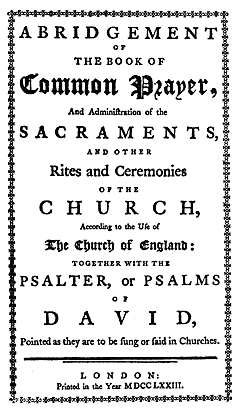
George Washington, for example, was a vestryman, but he never received communion in his adulthood. Martha always did, though, perhaps on behalf of the whole family. Ben Franklin rewrote the Book of Common Prayer to bring it closer to his own unusual faith (See here). Betsy Ross was a refugee from Quakerism, expelled when she married an Anglican. And Thomas Jefferson, well, he rewrote the whole New Testament, taking out the miracle stories because he didn’t believe in them. When Jefferson ran for president New England Congregationalists warned that if elected, he would confiscate all Bibles and convert churches into temples of prostitution. 

Like a number of people today, many of our colonial forebears preferred a more enlightened or scientific approach to the faith. You might also say that it was a somewhat more boring approach to faith—since everything one believed had to be subject to easy or scientific or verifiable explanation, with little room or justification for mystery. This was so much true that in the earliest proposed version of the Book of Common Prayer for the United States, they had wanted to omit the Nicene Creed from the Communion Service, because it was too hard for people to believe in it, and they condensed the psalms down to just a few. Ultimately, that proposed Prayer Book failed and the church officially adopted a more traditional faith, but with room for all sorts of questions and different interpretations. In the process, they embraced as much, if not more, diversity of belief as we have among us today.

Diversity of belief is not only at the heart of the Episcopal Church. It is also at the heart of American society. In fact, it is what we celebrate, really, on Independence Day. We celebrate the freedom to worship God in whatever way makes sense to us, as communities and as individuals—whether that’s with candles, chanting, and incense; with praise bands and hands uplifted in prayer; in Jewish synagogues praying and chanting in ancient Hebrew, thousands of years old; or even kneeling on carpets in a mosque. Central to who we are as Americans is the freedom, the liberty, to practice our faith and to speak to God and listen for God in the language of our hearts. Our responsibility, as Americans, and especially as Americans of faith, is to protect and preserve that freedom, that liberty, for others, and ultimately for ourselves. Yesterday we learned of the death of Holocaust survivor and Nobel Peace Prize winner Elie Wiesel. His life, his story, is the most profound and powerful reminder and witness to how important freedom of religion is for all of us, whatever our faith tradition, and how we have to defend it on behalf of each other.

Related to that idea, I think, is the belief, the value, that people don’t have to jettison their rich cultural backgrounds when they make their home here. Of course it’s important to try to live within the rules and structures of society—to follow the laws and such. But there’s nothing wrong, and probably there’s much right, with being proud of who you are, and where your family came from, and the traditions they brought with them—whether that’s pasta and tomato sauce, haggis and bagpipes, bagels and lox, or Lutefisk and St. Lucia. As you know, I largely identify with my Scandinavian heritage—Swedish and Finnish, that’s half of me. But I also have German and Irish and English heritage. Each is interesting, and each tells a story.

I had always thought that my ancestors, to a person, arrived in the United States during the waves of 19th century immigration. However, in doing research on Ancestry.com I discovered recently that my Cadwell heritage goes back to the 1600s here in New England, when the first Cadwell—Thomas—emigrated from Braintree, England and settled in Hartford, CT. In fact, he married the daughter of one of the founders of Hartford. His great grandson, John Cadwell, fought in the American Revolution for the patriots. So I could apply to be a son of the American Revolution if I wanted.

I also discovered that on my mom’s side, there was a German immigrant named George Kentner—something like my 5th great-grandfather, who came to the American colonies as an indentured servant in 1764. Eventually he earned his freedom and began life as a farmer in Pennsylvania. When the Revolution broke out, he sided with England and fought for the King. Ironically, he was captured and jailed in Hartford, CT—who knows, maybe he crossed paths with John Cadwell there. Great-grandpa George won his freedom by lying and saying that he would support the American cause. But he didn’t. He fled to Canada to regroup with the Loyalist soldiers called the Butler's Rangers. After the war, he and other German immigrants settled in a rural area of Ontario. They named their town Matilda, after a daughter of King George III. She later became the Queen of Wurttemburg in Germany. Eventually, a few generations later, after things calmed down his family filtered back down into New York and west to Minnesota and finally out to Oregon, where my grandmother was born. Thus, my family tree includes patriots and loyalists alike, as well as later arrivals from Sweden, Finland, and Ireland. I wouldn’t be who I am without that rich mix of backgrounds. And you wouldn’t be who you are without yours—loyalists, patriots, and later arrivals from Germany, Ireland, China, India, Italy, Mexico, and Armenia, to say nothing of the Native Americans who were already here and those who arrived in chains against their will.

That diverse combination of heritages and races, stories, beliefs and values is all part of the American fabric. And what a strong and durable fabric it is, too. The whole world is present here—every race, every religion, every background. We have Democrats and we have Republicans. We have socialists and libertarians, too. There are big sprawling farms in the Midwest—as in my home state of Minnesota—and there are massive cities teeming people speaking multiple languages and making a veritable smörgåsbord of ethnic foods (“smörgåsbord” —that’s a Swedish word, by the way, it literally means “sandwich table”—but now it’s part of our American English vocabulary as well). This country is so different, and I would say so much better, than anything our colonial ancestors could possibly have imagined when they declared their freedom and independence in 1776. We might add that England and Canada are a lot better, too.

Of course, it has not come to be without considerable struggle, pain, loss, and war along the way. We have not and we do not always live up to our full potential as a nation, as a people. Americans have sometimes kept other Americans in bondage—physical, emotional, and spiritual bondage. We have too often denied each other’s humanity and dignity, despite the fact that we declared our independence with words that have echoed through the centuries: “We hold these truths to be self-evident, that all men are created equal, that they are endowed by their Creator with certain unalienable Rights, that among these are Life, Liberty and the pursuit of Happiness.” We have not and we still do not always live up to these ideals. In fact the author of these extraordinary words didn’t live up to them himself, keeping his fellow human beings in slavery.

And yet, that transcendent vision, idea, and hope, first set to parchment by Thomas Jefferson so long ago, still calls to us today. In particular, it calls us embrace what it truly means to be American—which ultimately doesn’t have much to do with flying the flag or colorful bombs bursting in air, though there’s certainly nothing wrong with such acts of patriotism. Instead, it has everything to do with how we treat one another, with how we uphold one another, and with how we welcome, respect, and honor one another—not despite our differences, but because of them. Because these differences make us who we are—as a people, as God’s holy people—in this place, at this time. What an awesome calling it is. What a weighty responsibility it is. But also, what an example we can share and leave—not only for our fellow Americans, but for all people everywhere, longing for life, longing for liberty, and longing for the ability to pursue happiness, in freedom and in hope. 

Let’s hear again those words from St. Paul: “So let us not grow weary in doing what is right, for we will reap at harvest-time, if we do not give up. So then, whenever we have an opportunity, let us work for the good of all, and especially for those of the family of faith.”

That’s our charge, today and every day— do what is right, and work for the good of all—as Episcopalians, as Americans, and most especially and most importantly, as the people of God.

So let us pray:

O God, you made us in your own image and redeemed us through Jesus your Son: Look with compassion on the whole human family; take away the arrogance and hatred which infect our hearts; break down the walls that separate us; unite us in bonds of love; and work through our struggle and confusion to accomplish your purposes on earth; that, in your good time, all nations and races may serve you in harmony around your heavenly throne; through Jesus Christ our Lord. Amen.


© The Rev. Matthew P. Cadwell, PhD

Monday, June 20, 2016

Healing and Unity after Terror and Hate: A Sermon for the Fifth Sunday after Pentecost

In our reading from Paul’s letter to the Galatians we just heard:  

“For in Christ Jesus you are all children of God through faith. As many of you as were baptized into Christ have clothed yourselves with Christ. There is no longer Jew or Greek, there is no longer slave or free, there is no longer male and female; for all of you are one in Christ Jesus.”

This, I think, is my favorite passage in the whole of the Bible. And after the emotional challenge of the last week, hearing the stories of the 49 lives ripped away in Orlando last Sunday morning, as well as the others who survived, some barely, I find this passage from Paul to be healing balm for the soul. For all of the problems I sometimes have with the Apostle Paul, and I do have many, in this case he shines brightly. He grasps and presents in the most clear and articulate way possible what our life in Christ is all about.

Paul reminds us that in Christ all of our many differences and divisions are transcended and reconciled, and in their place a new kind of life has come into being. That new life is as the sons and daughters of God. And it includes each and every one of us—whoever we are, whatever our differences, in all of our sameness and in all of our diversity.

If I were asked what the center or core of my faith is, I think this is what I would say:  that in Christ we are united, made a new reality, and that the distinctions among us, even when they are great and seemingly significant, cannot truly divide and separate us. What’s more, it means that there must be room for everyone at God’s table and in God’s kingdom. And not only that there must be that room, but that there is that room. Because God has created that kind of room. And God’s wisdom, God’s love, and God’s embrace are wider and stronger and deeper than anything we can even imagine. I firmly believe that this is the message that we need to hear today, and this is the message that we need to share today. This is the message that will help to heal divisions among us across society. And it is the message that can help us defeat the distrust and even the hate that seems to continually fester in the world.

The past week has been so tremendously emotional and spiritually draining, as we learn about and reflect on the horrific events in Florida. It’s made all the more poignant by the fact that this past week was also the one year anniversary of the shooting at the Mother Emanuel African Methodist Episcopal Church in Charleston. Unfortunately, tragically, not much has changed in a year—except that these kinds of events are happening with greater frequency and with ever-higher causalities.

If I reflect back to a year ago, I remember how truly unsettling it felt to imagine that someone might join a Bible study—just like we have here every Wednesday night during the program year—and just as they began to pray together, he opened fire on people, simply because they were of a different race.  He claimed he wanted to start a race war. And now, with the shooting in Orlando, it is much the same.

Of course, we still don’t exactly know why the Pulse nightclub was chosen. But it seems not insignificant that it is a bar with a largely gay and lesbian clientele. Some politicians and others uncomfortable with who the victims were seem to want to downplay the fact that it was a gay club, focusing instead on the global terrorism angle. But I don’t think you can separate the two. He was clearly and specifically targeting gay people, just as the Charleston shooter was specifically targeting African Americans.

For me, and probably for you, it’s hard to understand how it is that human beings would even be able to consider such evil acts, let alone perpetrate them. As I wrote in my message to the parish this week, the perpetrator of the Orlando shooting was Muslim and claimed ISIS as an inspiration, while the perpetrator of the Charleston shooting was Christian—a Lutheran in fact, just like my upbringing, just like my family. Terror and hate can grow in the soil of any faith tradition. Whatever their religious backgrounds, both were deeply disturbed young men whose hearts were infected with hate. Perhaps they were even possessed and tortured by demons themselves, just like the man in this morning’s gospel.

Now, of course, we don’t tend to think or talk that way very much today—believing in demons taking control of our minds. That's now how we usually look on the world. But how else do we explain such heartless and cruel inhumanity? In other places in his letters, when St. Paul reflects on sin, he often describes it as an evil power or force that takes hold of us. Maybe there’s something to that old world view, at least in the most extreme cases like these. It’s probably as good an explanation as anything else.

But more important than that, whether or not there are demons, what we discover in this morning’s gospel story is that God meets us even in the darkest places of life. As the gospel explains to us, this poor man is so tormented that he doesn’t even live with people, but in a graveyard, among the tombs. And the evil spirits are so powerful in him that his neighbors tried to keep him in chains; though, the spirits were too strong for that. But they were not too strong for God. In fact, nothing is too strong for God. And no place is too dark or too God-forsaken for God’s touch, for God’s healing, for God’s love. Even a church or a nightclub held hostage by a murder with an assault rifle. Even there, even under those unimaginable circumstances, God was present, hard as it may be to comprehend. We have to believe that. In fact, we have to know that. If we believe in God at all, we have to believe that God was there.

As the last week wore on, we heard examples of the ways that God was present in the dark places of the nightclub last Sunday morning. God was present as friends and strangers comforted and held each other close. God was present as a mother at the club shielded her son from gunfire. God was present in the text messages people sent to their families and friends—expressing their love, some for the last time. God was present in the policemen who risked their lives to save others. God was present in the hours and hours of bravery and quiet courage. And, of course, God was present in drawing into his eternal embrace and love those who did not survive—whoever they were, whatever their background, gay and straight, women and men of every race and religion and background—49 beautiful, wonderful, fabulous people, who will never, ever be forgotten.

There is no possible way to make theological sense of Orlando, of Charleston a year ago, of Columbine or Newtown, or any of the tragic events that have become such a common feature of the American landscape, to say nothing of the terrors that people in other parts of the world experience each and every day. And clearly there are no easy solutions. If there were, someone surely would have come up with one by now. Personally, I am firm believer in gun control. I think it’s ridiculous that an ordinary person can buy military-style weapons for personal use. But I also know that even the strictest gun control measures won’t solve all of our most serious problems.

What’s really necessary is something else: transformed hearts. Hearts transformed by God. Hearts touched and healed by God. And, I think, we are starting to see that—though the progress can excruciatingly be slow. A year ago, after the Charleston shooting, pressure mounted for the removal of the Confederate battle flag on the State House grounds in South Carolina. It was a very small step. But, it showed that overt, authorized, and institutional racism has no place in our life together—and with that flag gone, perhaps one fewer child will grow up admiring it and thinking it reflects a better time, when some people owned others and kept them in chains.

Likewise, as we have heard the stories of those killed or hurt in Orlando, many are coming to the realization that LGBT people are just like everyone else, that they, that we, have families who love them, and hopes for their futures, and big gracious hearts. Perhaps because of this horrific event and the generous response to it by people and communities of all backgrounds, a young man or woman who is conflicted about his or her identity will be brave enough to claim it with out fear, and maybe parents or grandparents will realize that their son or daughter who just came out is still their beloved child. Maybe churches, synagogues, and mosques will recognize their LGBT members as beloved children of God as well. Perhaps we will all be emboldened to recognize that hatred and discrimination of whatever kind—racism, sexism, homophobia, xenophobia, or even of other religions—have absolutely no place in our life together, particularly if we are people of faith, particularly if we are people who believe in a God love, particularly if we believe in a God who loves and cherishes all people.

So, let’s hear again St. Paul’s powerful words: “For in Christ Jesus you are all children of God through faith. As many of you as were baptized into Christ have clothed yourselves with Christ. There is no longer Jew or Greek, there is no longer slave or free, there is no longer male and female; for all of you are one in Christ Jesus.”

This, friends, is the good news. This is the heart of the gospel. Whoever we are, whatever our backgrounds, we are loved. We are accepted. We cherished. We are the sons and daughters of God. It is the truth that we have to believe and it is the truth that we have to share, so that others believe it too. And so that we do more than believe it, so that we live it, each and every day, with all that we are.

I’ll close with the prayer I composed and emailed earlier in the week. I wrote it at the request of friend who was struggling to put into words all of her conflicting thoughts and emotions. Perhaps it is helpful to you, too.

Let us pray:

Out of the darkness of our divided world we cry to you, O God. We pray for those who died in Orlando a week ago--gay and straight, men and women, sons and daughters, partners, parents, and friends--a reflection of the human rainbow in all its magnificent colors. May they be united with you and all those whose names are written in the Book of Life. We pray also for those who were injured and look to you for healing. In your great love, O God, comfort those who mourn. Be with them in their sorrow, support them in their loneliness, strengthen them with courage. Break down every barrier between your people: where there is hatred, give love; where there is injury, grant pardon; where there is distrust, restore faith; where there is sorrow, renew hope; where there is darkness, let there be light. Grant us grace to contend against evil, and to make no peace with oppression, but to strive always for justice and reconciliation. Turn our deep feeling now into determination, and our determination into deed, that a new world may arise among us where we all may live together as your children in the bonds of peace and love. Amen.


© The Rev. Matthew P. Cadwell

Tuesday, June 14, 2016

Reflections on Orlando

On Sunday morning as we were celebrating our graduates and honoring our church school students and teachers for their fantastic accomplishments over the past year, other families were hearing the news that early in the morning a gunman had opened fire at a nightclub in Orlando--killing 49 people in the worst mass shooting in modern American history. The Pulse nightclub served primarily LGBTQ clientele, but not exclusively. Those who know it say that everyone was welcome there--men and women, gay and straight, young and older. It was for many a place of life--vibrant and joyful life. In fact, the club was established by a woman to honor and remember her brother who had died of AIDS. It was her way of keeping her brother alive by giving others a place of life and joy.

That this event happened during Pride month makes it all the more emotional. It could have happened here in Boston during Saturday's Pride Parade or in any of the clubs that people visited for celebration throughout the weekend. It is a tragic irony that it happened in Orlando, a city that Americans of every background associate with joy and celebration. In fact, there are even reports that the shooter had visited Disney World earlier that day. As the FBI investigates his religious, psychological, and social motivations and associations--he claimed inspiration by ISIS for this act of terror--we shouldn't lose sight of the fact that this was also a hate crime, directed against gay, lesbian, bisexual, and transgender people. He went into a gay club for the sole purpose of killing gay people. In that, this crime is not all that different, except in scope, from last summer's horrific killing of African American parishioners at the Mother Emmanuel AEC Church in Charleston, SC by a white racist, whom the congregation invited in for their Bible study. The sad irony is that the one year anniversary of that tragedy is later this week.

The Charleston shooter identified as a Christian. The Orlando shooter identified as Muslim. I will leave to others to determine whether this act is appropriately called radical Islamic terrorism or something else. But what I do know is that I don't want my faith to be associated with the perverted beliefs of the racist murder in Charleston, just as countless faithful Muslims in this country and across the world are horrified that their faith is being perverted by terrorists who are consumed with murderous hate and rage. You may know that for the past 16 years St. Paul's Episcopal Cathedral in Boston has hosted Muslim prayers every Friday afternoon. As a diocesan community, we have come to see this sharing of sacred space as a manifestation of God's love and care for us all. It is only by coming together in faith and prayer across our traditions that we can defeat hate and religious extremism. 

Last night, I started reading the biographies of those killed. They were real people with real lives and real loves. Sons and daughters, partners, parents and friends. I commend this link to you. See their pictures, and read their stories. It is a way to honor them as real people and not simply as statistics. http://www.theguardian.com/us-news/ng-interactive/2016/jun/13/orlando-terror-attack-victims-pulse-nightclub?

A number of vigils and prayer services are being planned throughout Massachusetts. Here are details on some of them: http://www.diomass.org/diocesan-news/local-prayer-services-all-affected-orlando-shootings

I also commend to you a reflection by Bishop Alan Gates on Orlando and gun violence in America. It is here: http://www.diomass.org/diocesan-news/hard-work-be-done-letter-bishop-gates-following-orlando-shootings

Finally, I want to share a prayer which I composed on Sunday night, at the request of a friend. I invite you to pray it now.

Out of the darkness of our divided world we cry to you, O God. We pray for those who died--gay and straight, men and women, sons and daughters, partners, parents, and friends--a reflection of the human rainbow in all its magnificent colors. May they be united with you and all those whose names are written in the Book of Life. In your great love, O God, comfort those who mourn. Be with them in their sorrow, support them in their loneliness, strengthen them with courage. Break down every barrier between your people: where there is hatred, give love; where there is injury, grant pardon; where there is distrust, restore faith; where there is sorrow, renew hope; where there is darkness, let there be light. Grant us grace to contend against evil, and to make no peace with oppression, but to strive always for justice and peace. Turn our deep feeling now into determination, and our determination into deed, that a new world may arise among us where we all may live together as your children in the bonds of peace and love. Amen.


The Revd Matthew P. Cadwell, PhD

Sunday, May 29, 2016

Healing in Charleston, Capernaum, and Hiroshima: A Sermon for Memorial Day Weekend


This past week, as the temperatures soared into the 80s and 90s, I finally clued in that summer is coming and I’d better make plans if I intend to do actually do anything. I’ve been in denial up until now. In fact, the snow shovel is still in the backseat of my car. But the calendar says it’s almost June, so I have started to think of travel options. Likely I’ll take my cancelled trip to Minnesota in August. The college committee I’m on will meet again then, and I have been considering going to Germany and Austria as well—Munich, Salzburg, and Vienna. When I was 14, I sang with a boys choir and we toured those cities, among others. I haven’t been back since, it so would be fun to go as an adult, when I can appreciate it fully.

That this is Memorial Day weekend is another clear sign that summer is closing in on us. Though, of course, Memorial Day is more than the start of the summer season, a time for big car sales or the opportunity to refresh your wardrobe with 70% off sales at Kohl’s. Memorial Day is a sacred time—to stop, to pray, and to give thanks for those who answered the call to service, and died fighting for their country. Many died in a valiant fight for justice and peace, and others in wars whose purpose were less clear. But regardless of government policy and what we think of any particular conflict, all were real life human beings, sons and daughters, people with dreams and hopes and lives to live. Lives that were taken too soon.

What’s particularly moving for me about Memorial Day is the fact that the soldiers we remember and honor were white and black, Native American and Chinese American; they were Christian, Jewish, Muslim, Buddhist, and atheist; they were straight and gay, married and single, some were parents and others barely out of high school. They were Democrats and Republicans alike. Most were men, but women die in military service, too. They are Americans, and more importantly, they are human beings, of every background.

While there are numerous stories and legends as to origins of Memorial Day, and claims by cities and towns to have hosted the earliest observance, it seems that the first widely publicized event was held in 1865, at the end of the Civil War. It was organized by liberated former slaves in Charleston, South Carolina, who beautified a burial ground for Union soldiers with flowers, inviting 3,000 freed African American school children, Union troops, black ministers and white missionaries to gather and pray together. An historian described the event: “African Americans invented Memorial Day in Charleston, South Carolina. What you have there is black Americans recently freed from slavery announcing to the world with their flowers, their feet, and their songs what the war had been about. What they basically were creating was the Independence Day of a Second American Revolution.” 

Over time there were more observances around the country, with numerous changes and developments along the way. For a long while it was held on May 30 and was called Decoration Day—that’s what my grandmother called it—until Congress formalized the name and re-established the date on the last Monday of May in 1968, principally to create a long holiday weekend. Many veterans groups would prefer it revert back to May 30.

So, it’s interesting that our gospel reading for today features a soldier—a centurion. A centurion was a commander in the Roman army, who had charge over 100 men, called a “century.” He wasn’t the highest authority in the army, but he wasn’t a nothing either. He was a mid-range officer—like a captain. Although strong, centurions were often the first killed or injured in battle because they usually led attacks, leading by example, rather than ordering their subordinates from behind. As a result, they were especially well regarded for their bravery, and also feared for their strength and fierceness.

Today’s gospel says that the centurion was in Capernaum, a village on the Sea of Galilee, and the hometown of several of Jesus’ disciples: the two sets of brothers, Peter and Andrew, and James and John, all fishermen, and also of Matthew the tax collector. It was a Jewish village, which served as the home base for Jesus’ ministry. Now, you might wonder why a centurion and his slave were there, probably with other men as well—maybe the whole century. Well, because they were Roman occupiers, making sure that the Jewish populace stayed in line and didn’t start any funny business, so that they knew who was boss. The centurion was a constant reminder of who was really in charge and had the power over people and their lives. And that was the Roman Emperor.

Luke suggests that this particular centurion and the Jewish populace got along well. He even helped them to build their synagogue. Though, it’s interesting that Matthew’s gospel, which also includes this story, makes no similar claim about the synagogue. Luke, who wrote a little later than Matthew, was probably trying to soften things, to make the centurion and his slave seem more deserving of Jesus’ mercy and healing power—in fact, he has the Jewish leaders come right out and say he’s worthy of mercy and healing. We should remember that Luke has a particular way of writing which makes the Romans seem more attractive than they really were, from the Jewish point of view—probably because he was trying to suggest to the Romans that Christians weren’t really a threat, they could live together, all of that. In reality, most of the people in Capernaum probably would have looked upon the centurion with suspicion and fear. He was a Roman soldier, an oppressor of the Jewish people, and as it happens, a man similar in to those who would one day crucify Jesus. 

Now, the healing in this passage is both interesting and significant. But to me, the more interesting and more significant aspect of the story is about transcending boundaries, overcoming prejudices, and accepting people for who they are, and not what they represent. What we think of as the miracle, the healing of centurion’s slave, is really the vehicle in the narrative (in fact we don’t even see the healing happen—it occurs off stage) for a profound and audacious act of boundary crossing by Jesus, who disregarded everything people had thought about who was acceptable and who was not, who was in and who was out. And in the end, the acceptance, the inclusion, and the healing of division ends up being the truly profound miracle. 

In a book called The Meaning in the Miracles, English theologian Jeffrey John has written: “It is important not to miss the extent to which the centurion in this story represents the foreigner, the oppressor, and worse. For Jesus’ contemporaries the centurion was a creature with supernaturally evil connotations, as well as being a symbol of all-too-real, earthly barbarism and cruelty. It was not for nothing that for three centuries Gentile soldiery had been thought of among Jews as beasts, subhumans or limbs of the devil. When Jesus so warmly commends the centurion for his faith, it is as if a survivor of Auschwitz has commended a Nazi kommandant. Yet for Jesus the weight of inherited group hatred counts for nothing. His immediate welcome of the man is an instance of his constant refusal to approach or judge people as members of a class, race, sex or category of any kind, but only as an individual. He deals with the human being, ignoring the label, and this is the heart of Jesus’ ‘inclusivity.’ To the consternation and disgust of others, he is completely non-tribal and prejudice-free….”
 
That’s powerful analysis, isn’t it? And, in fact, it’s exactly what we find throughout the gospels and throughout Jesus’ ministry: in the parables of the Good Samaritan and the Prodigal Son, in Jesus’ encounter with the Samaritan Woman at the Well and in the healing of the Syrophoenician Woman’s daughter, all foreigners or outsiders, whom the religious and social prejudices of the day would want exclude and ostracize. But not Jesus, who instead breaks down walls and barriers, borders and nations. Jesus calls us not to see enemies in our midst, but fellow human beings and even friends.

Of course, it can be hard to live up to that high calling. Sometimes it’s very hard, especially in societies that are so fractured and stratified and convinced that the only way for us to get ahead is by pushing others down. It can be hard in a world that is so addicted to war and death—in Jesus’ age, in our age, and in every age in between. But if Memorial Day reminds us of anything, it must be that life is better than death, that peace is better than war, and that friends are better than enemies—whatever their color, race, religion, nationality, or background.

We saw this lived out in a powerful way this week as President Obama visited Hiroshima. It was not an uncontroversial visit, of course. Healings across boundaries and difference rarely are uncontroversial, as Jesus showed us. But the result is, hopefully, a restored humanity. Now, no one apologized for the atomic bombs that took hundreds of thousands of lives and maimed even more, and neither did anyone apologize for the bombing of Pearl Harbor, nor for the horrors of the war that followed. The history and politics involved are probably just too complicated. Instead, they did what they could: they came together as human beings, in prayer and hope for a better future, for our people, for our nations, and for the world.

“Seventy-one years ago, on a bright cloudless morning, death fell from the sky and the world was changed,” President Obama said. “The world was forever changed here, but today the children of this city will go through their day in peace… What a precious thing that is. It is worth protecting, and then extending to every child. That is a future we can choose, a future in which Hiroshima and Nagasaki are known not as the dawn of atomic warfare but as the start of our own moral awakening.” It is powerful statement. It is a powerful hope.

But even more powerful than any words was the President’s embrace of the survivors of the Hiroshima bombing, and their embrace of him—people still bearing in their hearts, in their souls, and in their bodies the marks of that horrific day 71 years ago, when fire and death rained from the bright blue sky. The New York Times writes that the first of those survivors to embrace Obama was Mr. Sunao Tsuboi, aged 91, a chairman of the Hiroshima branch of the Japan Confederation of A-and H-bomb Sufferers Organizations. He gripped President Obama’s hand and did not let go until they had spoken for some time. “I held his hand, and we didn’t need an interpreter,” Mr. Tsuboi said. “I could understand what he wanted to say by his expression.”

Boundaries were crossed, divisions were transcended, and broken human lives began to be healed. On this Memorial Day weekend, if fallen soldiers and victims of war could reach out to us across time and across eternity, if they could grasp our hands and share with us the deepest thoughts and longings of their hearts, it would surely be much the same as we saw in Hiroshima. They would remind us of the preciousness of life. They would remind us of how short and uncertain life can be, and they would remind us of how we have to strive together for peace and understanding—so that their deaths will be the last. I believe if we in our time hear them, if we fulfill their hope for a better world, they won’t have died in vain. And Jesus’ vision of a restored humanity—manifest so powerfully in his encounter with the Roman centurion, breaking down walls and barriers and prejudices—well, that vision will truly come to life and we will all be healed. May we help God to make it so.

Let us pray:

O God our heavenly Father, look mercifully on the unrest of the world, and draw all people unto thyself and to one another in the bonds of peace. Grant understanding to the nations, with an increase of sympathy and mutual goodwill; that they may be united in a true brotherhood wherein are justice and mercy, truth and freedom, so that the sacrifice of those who died may not have been in vain; all this we ask in the name of Jesus Christ, who is the Prince of Peace. Amen.


© The Rev. Matthew P. Cadwell, PhD

Saturday, May 14, 2016

Choosing the Better Part: A Funeral Homily for Joyce Elliott

Now as they went on their way, Jesus entered a certain village, where a woman named Martha welcomed him into her home. She had a sister named Mary, who sat at the Lord’s feet and listened to what he was saying. But Martha was distracted by her many tasks; so she came to him and asked, ‘Lord, do you not care that my sister has left me to do all the work by myself? Tell her then to help me.’ But the Lord answered her, ‘Martha, Martha, you are worried and distracted by many things; there is need of only one thing. Mary has chosen the better part, which will not be taken away from her.’ Luke 10:38-42

I have to start by saying that perhaps like many, or even most, of you I am still in shock that Joyce has died. I am expecting to see her in church, working with the altar guild, in the office photocopying, or calling about this or that. It will take a good long while, for me anyway, to process this new reality. I will always treasure my memories of Joyce and will hold her in my heart—seeing her in her sparkly pink sweater, smiling brightly, bringing joy and love and care. And just as importantly, bringing her delicious Scandinavian almond cake to every church function. In many ways, she was like Emmanuel’s mother, grandmother, and aunt, all at once. 

As fast as everything has happened over the past few weeks, I also know that this is as Joyce wanted it—not us feeling loss as we do, but she being free from the health issues that made life so challenging and took so much from her in the last few years. And we know that she is reunited with the great love of her life, Ernie. Not a day went by, I think, that she didn’t think of him, and long for him—sometimes just the mention of his name made her well up with tears—of sadness I suppose, but also of love. In her last few weeks, seeing Ernie again was her greatest hope and anticipation. So, we can be happy for Joyce and Ernie—partners in life and now in eternity—even as we are feeling a little disoriented by this sudden change in our lives.

This morning’s gospel reading focused on two sisters, Martha and Mary of Bethany—friends of Jesus. Probably among his closest friends. It’s not one of the usual choices for a funeral, but I like it, as it tells of women of faith. Women a lot like Joyce.  Now, at first, one might think of Joyce as being more like Martha in this morning’s reading. Busy doing things. Rushing around. Making certain everything is perfect. Maybe a little anxious that every gets done as it should.

Whenever I hear that gospel I always sort of imagine Martha—the busy one—starting out subtly, making a little extra noise in the kitchen, banging pots and pans to get her sister’s attention and lure her out of the living room. It’s only after Mary doesn’t get the hint that Martha breaks a glass, blows up a little, and finally asks Jesus to intervene. I suppose we could see Joyce that way, women of the church often see themselves as Marthas—we even have a Martha stained glass window—with a small beehive depicted, the women of the church buzzing around, getting everything ready, as Joyce did week after week on the altar guild, and as church secretary during the 1980s and 90s.

But, of course, she was more than that. Because, like Mary in the gospel, Joyce also knew the importance of stopping to listen. Building and sustaining relationships were important to her. Knowing our stories was important to her. Somehow Joyce always seemed to know every detail about people's lives. Not in a gossipy kind of way, but in a concerned and caring way. Whenever I saw her, she was always asking how I am, how my family is—my mother in particular. Even when she wasn’t feeling well herself or in the hospital, she wanted to know about others. David and John shared that trips to the grocery store would typically include their mother striking up conversations with other customers in the check out line—people she had never seen before and might never see again. But she wanted to know them. She liked people. In fact, she loved people. With all of our gifts, with all of our mistakes, just as we are.

Time and again, like Mary of Bethany in the gospel, Joyce chose the better part, which can never be taken from her, or from us. That better part was opening her heart to us in love—whoever we are, wherever we are. And when you think about it, that is her greatest gift and legacy to us—her open heart. Well, that and the almond cake.

Nearly 8 years ago Joyce was one of the first parishioners I met. She made a point to welcome me to the parish—with the almond cake. Libby Berman and Anne Minton, the interim priests who preceded me, both said the same thing. They weren’t able to be here this morning due to family obligations, but they asked me to share how important Joyce’s welcome was to them, too. Over the years she shared details about the church and the town; more than once she guided me when I was lost, and of course, she offered lots and lots and lots of opinions. Usually when one such opinion was coming, or maybe a correction to something stupid I may have done, she would start with: “Now Matthew…” That was always a clue. Though, her most important opinion, which she reiterated often, was “it’s impossible to please everybody.”

Having been the church’s secretary for over a decade, working with 5 different ministers over the most tumultuous period in the church’s history, at least in the 20th century, she knew that better than just about anyone—it’s impossible to please everyone. Given that history, you’d think she would have stories to tell. And she did a little. But she never talked about rectors she didn’t like, or parishioners she didn’t like. Joyce’s guiding principle, so far as I could tell, was to like everyone. And to simply meet and accept us as we are. Joyce chose the better part.

My favorite Joyce story is of my first few months here at Emmanuel--in November 2008. She was having surgery at the Melrose-Wakefield Hospital and she called her whole family together prior to the operation. And by prior, I really mean prior—in the pre-op room. David and John and John were there, and me too—all crowded around her bed. At 7 in the morning or whatever it was. Always being a little nervous or anxious, she wanted prayers, just to be sure. I anointed her forehead, we prayed, and we talked.

And then, the surgeon came in to check on her. He probably made the mistake of asking if she had any questions. Because she did, but not about the surgery. She asked him: Did you sleep well last night? What did you eat for breakfast? She told him that she didn’t want any joking or silliness going on during the procedure. I think she even told him what kind of music she approved of and what kind she didn’t. If he was going to take her life into his hands, those hands had better be ready. We were all there together, until the very moment staff wheeled her into the OR. Of course, she came through just fine. After that, we were bonded for life. My great love of anything Swedish—expect lutfisk—that probably helped, too.

Like Mary of Bethany in this morning’s gospel, Joyce’s life was a life of faith. She believed in the steadfastness of God. She believed in the love of God. She believed in the power of God. While, like Martha in the gospel, Joyce was sometimes anxious about the many details of life, she was never anxious about the life of faith. Nor was she anxious about what comes next, on the other side of eternity. In fact, she looked forward to it, in faith and in hope. And, you know, it is that same faith and that same hope that draws us here together, and that allows us to commend Joyce to God, in the fullest, most certain confidence, that she is safe in God’s arms, that she is secure in God’s heart, that she is loved with the deepest, most all encompassing love possible.

We believe that because as Christians, we believe in the power of God. We believe in the power of the resurrection—both the resurrection of Christ 2000 years ago, and the resurrection that God continues to unleash in the world in our own lives. We believe, as Joyce believed for 81 years, that hope is always stronger than fear and that life is always stronger than death. This is the faith that sustained her, that gave her hope, and that led her to face the last weeks in strength, in courage, and in steadfastness of spirit.

The last time Joyce was here in church was for the Easter Vigil and tomorrow is the Day of Pentecost. It seems appropriate somehow that it is during this Easter season, this season of resurrection and new life, that Joyce that made her journey deeper and closer into the heart of God. Obviously, we would all want her to be here with us still. For more visits, for more joy, for more love, and definitely for more almond cake. But we also know that Joyce is now at peace. She is where she needs to be. She is finally, and fully, set free from all that constrained her, from all that made life hard over the last few years, and she is living at the heart of God, with Ernie, whom she loved so deeply.

So, we are called this morning to say goodbye. Not for ever. But for a while. Knowing that Joyce is safe. Knowing that she is at peace. Knowing that she is at home. Knowing that like Mary of Bethany, Joyce has chosen the better part that can never be taken from her. We miss her. I miss her. But our comfort, our consolation, and our hope comes in knowing that for Joyce, today and every day, is a bright Easter morning. For Joyce, today and everyday are days of joy and not sadness. They are days of life—eternal, abundant, resurrection, Easter life. And to that, what can we say but “Alleluia, alleluia, alleluia.”

I would like to close by offering a prayer—in honor of Joyce and Ernie both—in Swedish. And then I’ll read it in English, too. Let us pray.

Käre himmelske Fader. Vi tackar dig för att du genom Jesus Kristus har skänkt oss det eviga livets gåva. Hjälp oss att tro hålla fast vid att ingenting kan skilja oss från din kärlek. När vi mister någon, som står oss nära, hjälp oss då att ta emot tröst från dig och dela den med varandra. Vi tackar dig för vad du gav och genom Joyce och Ernie. Åt dig överlämnar vi oss som vi är med vår saknad och vår skuld. När rätta stunden är inne, låt oss då få dö i frid och se dig ansikte mot ansikte, du vår frälsnings Gud. Amen.

Dear Heavenly Father, we thank you that through Jesus Christ you have given us the gift of eternal life. Help us to hold fast to the belief that nothing can separate us from your love. When we lose someone close to us, help us then to receive consolation from you and to share it with each other. We thank you for all you gave us through Joyce and Ernie. We commit ourselves to you, as we are, with our longings and our faults. When the right time comes, let us die in peace and see you face to face, O God of our salvation. Amen.

© The Rev. Matthew P. Cadwell, PhD

Saturday, May 7, 2016

Distinguished Alumni/ae Award: Peter Selby

EPISCOPAL DIVINITY SCHOOL

Distinguished Alumni/ae Award

The Right Reverend Dr. Peter Selby  ‘66


Bishop and Theologian
Visionary for Justice and Inclusion in Church and Society

In an article titled “Risk, Fear, and Faith”—focused on Britain’s banking system— Peter Selby wrote: “There is no human event, from falling in love to learning to swim, that does not involve at some level the overcoming of fear... Therein lies the meaning of the most repeated biblical injunction, ‘Fear not’: it is not that we are to avoid noticing what are the forebodings and anxieties that threaten to make fear the wellspring of action, and as a result to lead us into wrong decisions; rather it is a call to a proper assessment of our fears and the harnessing of the inner resources of love and faith to overcome them.”

This reflection has relevance beyond the contexts and issues originally addressed. Fear is all around us—in the rapidly changing institutions of theological education, in the wider community of the church, and in societies concerned with their own safety and prosperity. Since his graduation fifty years ago, Peter Selby’s ministry has focused on encouraging and empowering the people of God to overcome fear by harnessing the inner resources of love and faith.

Perhaps the first clue that his life and ministry would be characterized by this confrontation of fear with faith was his decision to leave Oxford and travel across the ocean to study in this place. Here on Brattle Street he met professors and classmates—likewise following the risky and faithful call of the gospel—who have challenged each other and sustained profound friendships across time and across oceans. One of those classmates, supporting and challenging, across time and space is Jonathan Daniels.

Peter Selby’s ETS education led him to answer an even riskier call to travel further west, to the other US coast, where he pursued Clinical Pastoral Education at none other than San Quentin Prison. It was a transformational experience that would lead to a life-long concern for criminal justice and, in particular, for ministry with prisons.

Upon graduation, Peter worked as a curate in an increasingly multicultural London parish, followed by educational ministry for the laity, doctoral studies in New Testament, and a canonry in Newcastle on Tyne. Along the way, he married Jan and raised three children. Jan undertook a leading ministry of her own. With friends she founded NOW—the Newcastle Ordination of Women group—meeting, lobbying, campaigning for the change that is only now coming to full realization with the ordination of women to all orders of ministry in the Church of England.

Peter Selby was appointed to the episcopacy during Margaret Thatcher’s premiership, serving the Diocese of Southwark in south-west London. It was a ministry that required the skill of a faithful pastor at a time of social upheaval and divided visions for the nation. After 8 years, he turned his attentions to academe with a fellowship at Durham University. There he began pioneering work in thinking theologically on the nature economic debt. His book Grace and Mortgage: the Language of Faith and the Debt of the World has been cited as prescient of the financial crisis of 2007.

He returned to church leadership with an appointment as Bishop of Worcester in 1997, including membership in the House of Lords—surely not a typical honor for an EDS alumnus. But he used that position to advocate on criminal justice issues, leading to an appointment by the Archbishops of Canterbury, York, and Wales as Bishop to Prisons. Notably, he celebrated the Eucharist in a jail every Christmas Day, sharing the incarnate love of God with those often forgotten by society. Upon retirement, he assumed the presidency of the National Council for Independent Boards –monitoring the treatment of those in custody – both in prison and immigration detention. Subsequently he has worked with St Paul’s Institute, seeking to engage with the financial sector of London. His most recent book is An Idol Unmasked: a Faith Perspective on Money.

As bishop Peter Selby has consistently combated the institutional fear evident in the Lambeth Conferences’ and the Church of England’s sexuality-based restrictions on ordination. Instead he has drawn upon the inner resources of love and faith to argue in favor of marriage equality in church and society. And he has served as one of two Episcopal Patrons of the international No Anglican Covenant Coalition, helping to defeat it in England and across the Communion.

In his first book, Look for the Living: the Corporate Nature of Resurrection Faith, published in 1976, Peter Selby wrote: “I have been constantly aware of the debt which I owe to my teachers at the Episcopal Theological School in Cambridge, Massachusetts, and in particular to Dr Harvey Guthrie and Dr Lloyd Patterson, whose course on ‘Biblical Eschatology and the Church’ has continued to offer me a framework of theological thinking which can move critically with change.”

Bishop Peter Selby, over his long and extraordinary vocation in ministry, has confronted fear with faith, taken risks, and stood steadfastly for the gospel, thinking theologically and moving critically with change. In the process he has broken down barriers and shone the love of God in the darkest corners of society. For his extraordinary vision and commitment, for his lifetime of ministry embodying EDS’s historic and current mission, and most importantly for his embrace of the call to confront and overcome fear with faith, love, and risk, I am pleased to present Peter Selby ‘66 with the Episcopal Divinity School’s 2016 Distinguished Alumni/æ Award. 

Matthew P. Cadwell ‘99
Co-President
Alumni/ae Executive Committee

Tuesday, January 19, 2016

On Weddings, Wine, and Anglicans: A Sermon following the Primates' Meeting


They say that all publicity is good publicity, but I have to admit that I cringe every time the Episcopal Church makes the national or international news, as we did this week. Because almost always it has to do with some knock-down drag out fight. And even more because almost always, these days anyway, it has to do with gay and lesbian people. 30 or 40 years ago the fights were about women. But those disputes are in the past, or at least are buried under the surface. So that now, it’s about who’s welcome, who’s not welcome, and which sacraments are open to which members—notably ordination and marriage. In this case, the issue is marriage.

Which is kind of coincidental, since this morning’s gospel focuses on a wedding. Of course, it is a wedding in which something unusual, unexpected happens, as Jesus miraculously changes jugs of water into wine, so that, thankfully, the partying can continue. Apparently, the couple didn’t buy enough. Only, you may have noticed that it was a lot of water that Jesus transformed into wine—not just a couple 750 ml bottles, but six stone water jars, each holding 20 or 30 gallons. Jesus changed between 120 and 180 gallons of water into wine.

We tend to think of wine in terms of bottles, not gallons. So I did a little calculation. There are about 5 bottles in a gallon. So that’s means Jesus transformed enough water into wine to fill between 600 and 900 bottles. That would make for one heck of a wedding banquet. And, we read that it wasn’t the cheap “Two Buck Chuck” from Trader Joes, either. Rather, it was the good stuff. The really good stuff, maybe equivalent to a $50 bottle. If you figure 600-900 bottles at $50 a bottle, that’s between $30,000 and $45,000 of wine!

Why did Jesus go so far over the top? Well, I think it’s to show that the grace and love of God abound. They overflow even, beyond our wildest imagining. God’s grace and love, Jesus shows us, bring joy and life, not just to a few, maybe not even to just those who have been invited to the wedding banquet, but to the multitudes. After all, with so much wine, so much blessing, you’d have to share it—widely, liberally, abundantly.

Back to the news: this week the Episcopal Church in the United States was punished or sanctioned, given a time out, or sent to stand the naughty corner, whatever you want to call it, for three years, for having made the decision this summer to finally and formally authorize marriage equality for all couples, across the church. This momentous decision, made by the General Convention in July, came just a couple days after the Supreme Court issued their landmark ruling. So, almost immediately after marriage equality became US law, it also became Episcopal Church law. Of course, the two processes were separate. The church could have stated that our understanding of marriage is limited to opposite-sex couples—lots of churches do that; or we could have said that same-sex couples can have their relationships blessed, but they wouldn’t be marriages in the sacramental sense, which was our approach for the past 15 years or so.

But this time the Episcopal Church didn’t do that either. This time we opted for the most inclusive approach, after years and years and years of debate and struggle, after prayer and conversation and conversion. In fact, the debates had been ongoing for such a long time that by the time our representatives finally voted this summer in Salt Lake City, there was very little opposition, even among the bishops. Whatever our grand and glorious history in the halls of money, power, and privilege, today the Episcopal Church is also a church of inclusion. Or at least we strive to be. We undoubtedly fail plenty often. But our goal, I think, is to be a church that manifests the abundant love of God that overflows and blesses all people, just like the miraculously endless supply of wine at the wedding feast in Cana.

As wonderful as that sounds, and as much as it draws many of us to make the Episcopal Church our home, this decision has gotten us into some trouble with our brother and sister Anglicans across the world. Now, they don’t have any authority to prevent us from governing our life here or making our own decisions. The Episcopal Church is autonomous, as are all Anglican or Episcopal churches across the world, 38 of them in 165 countries, with as many as 85 million members. Unlike the Roman Catholic Church, we don’t have an Anglican pope who can direct policy in far flung places. There isn’t even any legislative body that can do that. Though there are a number of committees and gatherings that speak on behalf of the Anglican Communion and that work to hold us together in all of our diversity. 

This week one of them met—the Primates, they are called—meaning the archbishops and presiding bishops of these 38 Anglican churches. Our new Presiding Bishop Michael Curry was there, as a full and equal partner, for his first meeting with this group of bishops. Now, as you may know, for some time—at least since 2003 but really much longer than that—there has been deep frustration in other parts of the world over the Episcopal Church’s growing inclusiveness regarding human sexuality. Usually, we are not the only ones singled out. Canada is problematic, too, but they haven’t gone quite as far yet in terms of marriage. They plan to vote on marriage equality this summer. The Scottish Episcopal Church has also begun a process that might lead to the same conclusions: that our church and its sacraments are open to all and there will be no outcasts. But they aren’t there yet either.

So, frustrated by our decisions, these archbishops meeting in England voted to limit the Episcopal Church’s voice in international ecumenical and interfaith dialogues, as well as in decisions related to Anglican doctrine and governance. It’s an open question as to whether or not they actually have the authority to take this action, many disagree, but for the time being we can assume that they do.

What they did not do is throw the Episcopal Church out of the Anglican Communion. Some archbishops would probably like to do that, they even tried to get us and Canada to leave voluntarily, but they don’t actually have the power to make it happen. So instead, they threatened that if some action were not taken they would up and leave, potentially causing a major global schism, with the liberal churches in Canada, the US, the British Isles, Australia, New Zealand, Brazil and maybe South Africa forming one, mainly white and rich Anglican Communion, and the more conservative churches in Africa, Asia, and South America forming another, much poorer in financial wealth, but abundantly rich in membership. We would be a truly broken and divided body if that were to happen, very far from the Body of Christ. So, this week’s punishment of the Episcopal Church, sending us to stand in the naughty corner, was perceived to be the minimum action necessary to prevent a global walk out.

So, that’s where we are. Now, of course, at some point someone could decide to call it quits: the Episcopal Church could say we’ve had enough of this. We’re tired of defending our decisions and our call to welcome all people in our churches. And others could call it quits, as well, after years of dealing with us “heretical” Americans. And it might some day come to that. But so far, we’ve discerned that it’s better to at least try to live together and learn from each other, in the same Anglican family, with a shared and cherished heritage, even as we also try to live in the present moment and meet the spiritual needs in our own contexts. In fact, this has always been one of the chief hallmarks of Anglicanism—that we share a heritage, growing from the rich life of Church of England, but always ministering in our own languages, in our own places, and in ways that make sense and meet the needs of people where we are. That’s really what it means to be Anglican, and so far no one wants to give up on that ideal, nor on the deep and profound relationships with real life human beings across the world that our Anglican identity affords us—people we might not otherwise know. So, like real life families, we love and we fight. Some of us, unfortunately, don’t speak to others. But maybe we have cousins that we all talk to and who hold the family together. And, whatever our disagreements, we undeniably share the same genes, the same DNA, whether we like it or not.

What’s most sad for me in all of this is an increasing belief among some that our unity must come from us all believing the same things or acting in the same ways. That has never really been the Anglican way. Instead, Anglicans have believed that our unity is a gift, from God. We do not create it. It comes from Christ, it comes through Christ, and it comes in Christ. It comes by virtue of the fact that the church, the Body of Christ, in all of its human beauty and diversity and limitation, is nothing less than the extension of the Incarnation in the world. God came among us in Christ, to take our humanity into himself—not just some of us, not just those of us who believe one way or another, or who live one way or another, but all of us. And so our unity is always also in Christ, strengthened, supported, and enlivened by our fellowship, by the sacraments, and by our shared, common prayer. But always rooted in Christ.    

I thought I would close by sharing some reflections from Presiding Bishop Michael Curry, after the meeting in London. We can hear the pain in his words at the lack of unity among our global family, but also his extraordinary faith. He said:

“Many of us have committed ourselves and our church to being ‘a house of prayer for all people,’ as the Bible says, where all are truly welcome. Our commitment to be an inclusive church is not based on a social theory or capitulation to the ways of the culture, but on our belief that the outstretched arms of Jesus on the cross are a sign of the very love of God reaching out to us all. While I understand that many disagree with us, our decision regarding marriage is based on the belief that the words of the Apostle Paul to the Galatians are true for the church today: All who have been baptized into Christ have put on Christ. There is no longer Jew or Gentile, slave or free, male or female, for all are one in Christ."

"This has been a disappointing time, and there will be heartache and pain for many, but it’s important to remember that we are still part of the Anglican Communion. We are the Episcopal Church, and we are part of the Jesus Movement, and that Movement goes on, and our work goes on. And the truth is, it may be part of our vocation to help the Communion and to help many others to grow in a direction where we can realize and live the love that God has for all of us, and we can one day be a Church and a Communion where all of God’s children are fully welcomed, where this is truly a house of prayer for all people. And maybe it’s a part of our vocation to help that to happen. And so we must claim that high calling; claim the high calling of love and faith; love even for those with whom we disagree, and then continue, and that we will do, and we will do it together. We are part of the Jesus Movement, and the cause of God’s love in this world can never stop and will never be defeated.”

May that love, like the wine at the wedding feast, overflow and embrace us and all people, with even more left over.

To God be the glory: Father, Son, and Holy Spirit. Amen.


© The Rev. Matthew P. Cadwell, PhD