Shining Beacons of Light

Shining Beacons of Light

Monday, February 10, 2014

On Salt, Light, and the Little Church on the Prairie: A Sermon for the Fifth Sunday after Epiphany

From time to time, over the past five and a half years, I’ve reflected in sermons on my conversion from the Lutheran church of my upbringing into the Episcopal Church, which I joined officially just about 20 years ago. It seems like a very long time ago now, about half my life, but at the time it was one of the hardest decisions I had ever come to. I know some of you who have come from other traditions have felt the same way, too—that you are somehow turning your back on all that was most important in your life for this new thing. Yet, there was something about the Episcopal Church and the Anglican tradition that had a special draw or lure for me, from the time that I first really learned of it while I was a college freshman.

Like most people, I already knew some of the less flattering stuff: Henry VIII, his divorces, beheading wives, naming himself the head of the Church in England, but I didn’t know any deeper details. When I finally learned more, beyond the scandalous tabloid-type history, in a college class called “Religion in America,” I was quite intrigued. In particular, I was attracted by my professor’s description of the Episcopal Church as being theologically open or even liberal, while maintaining a traditional, Catholic liturgical heritage. Before I had ever even stepped foot in an Episcopal parish I had come to the conclusion that it was the church for me. (My professor did also note, as something of an aside, that the Episcopalians never prospered out on the prairies or in the west, since they felt the need to carry so much heavy “stuff” with them—vestments, silver chalices, brass candlesticks, stained glass. Other traditions were lighter and more nimble, better suited to westward expansion, and thus ended up being bigger in the long run.)

My first visit to an Episcopal parish was to the Church of the Holy Communion in St. Peter, Minnesota, when I was a sophomore. I went with my friend Susan, who is Methodist but had attended before (plus, she had a car). I approached that visit with a sense of great anticipation, expecting there to be billowing clouds of incense and beautiful vestments, along with an erudite sermon filled with philosophical theology or something. That was what I was looking for at the age of 20. Only, it’s not quite what I found. Because, you see, the Episcopal parish in my college town is small. Smaller than Emmanuel—both in terms of the building, which probably seats about 100 people at most (we seat 150), and also in terms of the congregation.

The building, which is very nice, was constructed in 1869, 12 years before ours, of sandy-colored Kasota stone. It’s “A-framed,” with a very steep high peak, a small bell tower at the back, and the distinctive Episcopalian red front door. The first bishop of Minnesota, Henry Whipple, called it the prettiest rural or village church he had ever seen. Most were wood, so a stone church out on the frontier prairie must have seemed like a real extravagance. The town’s founder, a military captain, held the first service in his home in 1854, officiated at by the great western Missionary Bishop Jackson Kemper. The whole town attended—all 37 people. Captain Dodd eventually donated the land for the church and is buried behind it. The congregation today, 260 years later, if everyone is included, totals about 90 people, with an average attendance of 35. Of course, the city of St. Peter is only 11,000. So, as a percentage, Holy Communion’s membership and attendance are not too dissimilar from ours here in Wakefield, which is just a little more than twice as large at 24,000.

Well, instead of my dream church, with those billowing clouds of incense, what I found instead at the Church of the Holy Communion was a community of real people. A few of them were my college professors. There’s a philosophy professor I had who is very active in the parish, as well as a married couple, both Classics professors—one who taught Latin and the other Greek. The biggest surprise was that the Lutheran college chaplain’s wife was a member. I guess she didn’t feel the need to hear her husband’s sermons every week. And then there were people previously unknown to me, all kinds of people, really, from all kinds of backgrounds. They did not have a choir, but they had an organist whom I talked with a lot. What I remember especially about her is that she was first trained to play the accordion. They didn’t have Sunday bulletins either, just the readings insert. People looked up at the hymn boards for music (it was the first time I had ever seen hymn boards!) and they followed along in the Prayer Book, which was confusing to me at first, since the liturgy seemed to jump around a lot. If I remember correctly, after the service you had to walk outside and into a separate building for coffee hour.

And yet, despite its relative modesty, people kept (and keep) coming back. I did, too, off and on, until I graduated (though 9:30 service times weren’t always so attractive to this college student). There was something special, holy even, about that place, that community, which drew people in and gave sustenance and seasoning to life. The church and its people, to quote Jesus, were “the salt of the earth” and “the light to the world.” I suppose they weren’t the most “successful” by the standards of church growth, or prestige or anything like that. But, they were, and I assume still are, really wonderful. I just wish I had been less shy and more outgoing, so that I could have engaged that time and opportunity better. I wish I had let my light shine, to use Jesus’ imagery.

Today, I often think about the Church of the Holy Communion and how similar we are here at Emmanuel. It’s true that we’re somewhat bigger, in terms of congregation size, budget, even the building (though I do have very romantic feelings about that historic little church on the prairie, wishing it could be magically transported here, at least the outside. I’m very partial to our insides after all of the renovations we’ve done). But like them we are, by the standards that many of us have been used to from other denominations, also rather small. I hear that a lot from people—both long time parishioners and those who are new to us—that we are small.

What you may not know is that 68% of Episcopal congregations have fewer than 100 people in church on an average Sunday. 68%. In fact, the median average Sunday attendance across the Episcopal Church is 64 people, smaller than us by a fair margin when you add together our two services. We are just part of a denomination that, for a number of reasons, has favored smaller, more intimate parishes. I think it’s reflective of our English heritage, with little country churches in every town and village, rather than big mega churches that are more of a North American phenomenon. Of course, there are some big, impressive Episcopal churches, like Trinity in Copley Square, Epiphany in Winchester, or the National Cathedral in Washington. But they are not the norm. The norm, all across the country, are smaller, intimate, pastoral-sized parishes, parishes a lot like Emmanuel.

Maybe it’s because, as my college professor said, those early Episcopalians got too loaded down with “stuff” to do a good job of expanding. Or, maybe, it’s that our approach to faith and spirituality does not appeal to everyone. After all, not everyone likes smells and bells, let alone the ambiguity of unanswered questions in place of certainty. Even lots of Episcopalians don’t like those things. I suspect it also has to do with the fact that after a time there just weren’t so many immigrants to the U.S. who were Anglican. The English stopped coming very early on, replaced by Irish, Italians, Scandinavians, Germans, Poles, and now Latin Americans, Asians, and Middle Easterners, all who have brought other faith traditions.

But you know, whatever the reasons, size is not a measure of strength or effectiveness. Certainly it’s not a measure of depth of faith, as that little church on the prairie has made plain for 160 years. What matters is how we live our lives of discipleship. How we embrace our calling to be, as Jesus says, the salt of the earth and the light of the world. And that’s something that I think Episcopalians have been very good at: understanding that our numbers aren’t determinative for the impact we can have. That, too, along with the liturgy and theological openness, is part of what drew me to this church 20 years ago, joining that history, adding my voice to those in previous generations who have used their gifts and their lives to bring the kingdom of God that much closer—whether in fighting for civil rights on the streets or in court rooms, as an Episcopalian named Thurgood Marshall did for decades, or in serving dinner at Bread of Life in Malden this Thursday. In shattering the stained glass ceiling like Massachusetts’ own Bishop Barbara Harris, the first woman bishop of any tradition anywhere in the world, consecrated, as it happens, 25 years ago this week, or in striving to preserve the environment through Green Grants that are transforming our churches and helping us to leave a smaller imprint for the next generations. All are examples of adding salt and savor, light and new perspective.

What’s especially interesting, I think, is the fact that when Jesus uses the metaphors salt and light, he’s speaking of things that are small, but can have a big impact. Take salt: you don’t want to eat a dinner plate full of salt. Just a sprinkling is all you need to bring life to your food. And the same is true for light. When Jesus spoke, light was a rarer commodity than it is today. They didn’t have light bulbs or electricity and you couldn't just flip a switch. So, much more of life was spent in the dark. A single flame from a candle or oil lamp made all the difference between being able to see and utter darkness.

And that, Jesus tells us, is our calling as his disciples, as well: to add seasoning and taste, and to help others to see. We don’t need for everyone to become just like us. After all, no one wants to eat a bowl of salt. Instead, we need simply to cast enough light, and add enough savor to help others see and know God, as we have in our lives, but with their own eyes, in their own way. When we do that, we will have done our job and answered Jesus' call well. But, we have to do it. We have to add savor. We have to pierce the darkness, so that others can see. We can’t be so small, so limited, or so private that we don’t fulfill either our calling or our potential. In other words, our motivation, our drive, has to always lead us outward—to bring light and seasoning, glimpses of hope and peace, knowledge of God and the good news of God’s kingdom.

Part of that good news is that we don’t need to be especially big to do those things. After all, there were only 12 apostles at first. And we’re a lot more than 12 (often even at the 8:00 a.m. service). We just need to believe, really believe, that we are who Jesus says: “You are the salt of the earth… You are the light of the world…. No one after lighting a lamp puts it under the bushel basket, but on the lampstand, and it gives light to all in the house. In the same way, let your light shine before others, so that they may see your good works and give glory to your Father in heaven.”

To God be the glory: Father, Son, and Holy Spirit. Amen. 


© The Rev. Matthew P. Cadwell, Ph.D.
Sunday, April 21, 2013

On Terror, Hope, and Resurrection: A Sermon for the Fourth Sunday of Easter


Last Sunday morning, when we gathered here for worship, none of us could have imagined the week that would unfold before us.  Do you remember what you were thinking about then, last Sunday?  School vacation week maybe, or watching the Boston Marathon?  Finishing up your taxes, possibly a Monday off from work, maybe a spring clean-up of your yard, or even a trip somewhere? Taxes were certainly on my mind—I knew I owed some, but wasn’t sure how much and dreaded finding out for certain—plus I had a lot of concern that my second box of completed thesis copies, which I copied and sent the day before, would make it to Toronto without incident, unlike the first box that got waylaid along the way. (It did make it, by the way, on Wednesday as scheduled).  I was also thinking about meetings to come and pastoral concerns and who knows what else.  

Well, the two homemade bombs at the Marathon changed all that—for most of us in a less profound way, mainly—but for others far more permanently, as they lost people they love and as some were injured unbelievably.  Since Monday afternoon we’ve all been on an uninvited and unwelcome roller-coaster of emotion: shock and fear, then a degree of resolve, inspiration and hope, and then more shock, more fear, more anxiety, and finally, Friday night, some sense of relief. 

My mother called me on Saturday morning, saying that I must feel good that it’s all over.  And I do.  Or at least I feel relief that the two suspects can’t hurt anyone else.  But of course, it’s really not all over.  There’s so much that we don’t know and don’t understand yet, if ever.  Unfortunately, it may be quite some time before our many questions are answered, the most important of which is simply: “Why”?  Why would anyone want to disrupt something as joyful and innocuous as the Boston Marathon?  Why would anyone want to indiscriminately hurt and kill people he or she didn’t even know?  Why here?  Why now?  Just, why?

And then when the photos and the identity of the suspects were revealed, we might have wondered, too, and we might wonder still, why young men like those we presume did these horrible acts—with their futures ahead of them—would want to throw their own lives away for seemingly no reason, along with those they hurt and killed.  A few moments of attention is all they got out of all of this, and even that wasn’t so glamorous.  Certainly they didn’t become heroes of anything or anyone.  The younger brother, especially, seems to have really had a lot to live for: a graduate of the Cambridge Rindge & Latin School, with a college scholarship, recently made a U.S. citizen, lots of friends, great sense of humor, even a nice disposition.  But the older brother, too, about whom the deeper concern is centered, had some good things in his life, too—extraordinary talent as a boxer, also talent as a musician, a family that loved him, even it seems, a wife and a two-year old baby.  Why throw all of that away for nothing good?

Surely these brothers didn’t think they could just return to their normal lives on Tuesday morning, without notice, as if nothing had happened.  And the presence of several bombs and explosive devices in their apartment would suggest that they didn’t really expect to, either.  Or at least one of them didn’t.  Maybe over time we’ll get answers, at least partial, to some of these questions that still hang over us.  Though, we’ll probably never really, totally, know.  And we’ll never totally be the same as we were on Monday morning, either. 

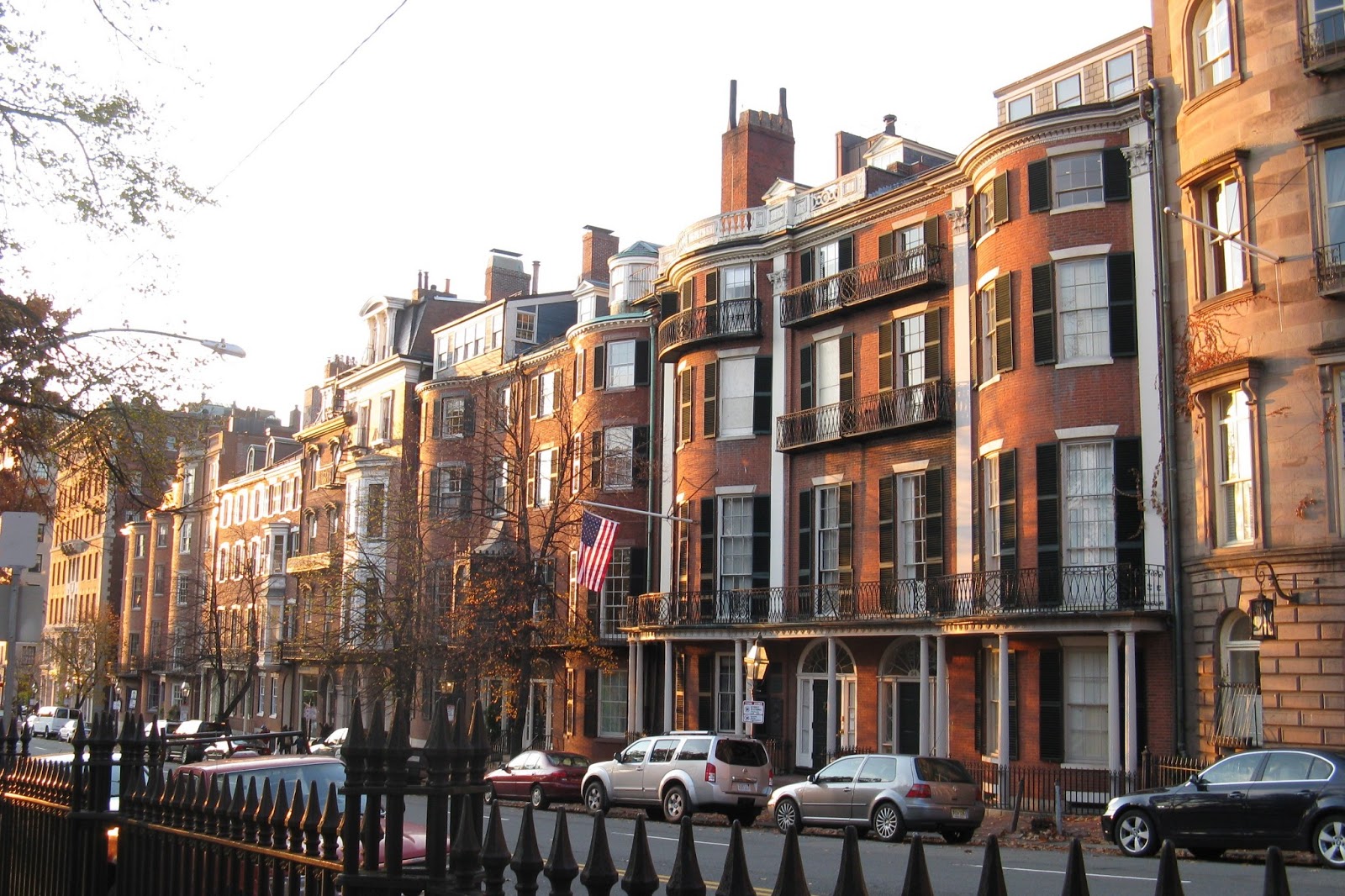
But in the meantime, we go on with our lives, because we have to.  Not the same.  Not untouched.  Not unchanged.  But still moving along, moving ahead.  I thought about that on Thursday morning—before the extraordinary dramatic events of Friday—when I was in downtown Boston following an early budget meeting at the cathedral.  Usually after these things I just head home on the subway—diocesan budget meetings are exhausting, especially when they start at 8 a.m.  But Thursday was an especially beautiful day and I didn’t really have to be anywhere in particular for a while.  So, I walked leisurely through the Boston Common and then down Charles Street on Beacon Hill—one of my favorite streets in the city.  It was so gorgeous that bright spring morning.  In fact, it seemed even more gorgeous than ever.  Flowers were starting to bloom, birds were chirping, I paid special attention to the unique majesty of Beacon Hill’s architecture.  It all was like a special gift from God.  Like I was in the most beautiful city in the world, or if not the world, then certainly the United States.  I’m not sure Boston is quite as beautiful as Stockholm, but it’s close.

In fact, I was so inspired by the day that I had decided to spend a bucket load of money at a Scandinavian antique shop I had stepped into the week before, to buy something I wanted but really didn’t need, to heck with my shrinking checking account, and thankful to be alive and able to enjoy life in this gorgeous city and determined not to let terrorism stop me from doing what I wanted.  As it happens, though, the antique shop was fortuitously closed.  So, instead of spending a small fortune that morning, I enjoyed a much less expensive coffee and almond croissant at the cafĂ© next door—that seemed like an economical tradeoff.  And while I sat there, sipping my coffee, with a pretty tulip in a bid vase on the table, and looking out the window onto the bustle of Charles Street, I thought to myself, no bomb and no terrorist is strong enough to take any of that away from me, from us.  

Of course, that all was before the later drama of Thursday and Friday: President Obama’s visit and the inspiring Interfaith service, then the FBI’s release of the pictures of the suspects, followed just a few hours later by the murder of the MIT police officer, the carjacking, chase, horrible shootout in Watertown, and then the lockdown, manhunt, and finally capture.  I admit that some of that the joy, inspiration, and resolve I felt on Thursday morning on Charles Street was tempered again by a degree of anxiety and fear as I watched what was going on in Watertown, and I wasn’t even in the lockdown area.  Those of you up here in and around Wakefield were even further away from the nexus, but I imagine there was a good degree of anxiety here, too.  How could there not be?  I can’t begin to imagine what the people of Watertown must have been feeling through it all: hearing the gun fights, explosions, and opening their homes to SWAT Teams, to say nothing of the man who found the younger suspect in his boat.  The very thought of that discovery makes me absolutely ill. 

But even on Friday, as our doors were locked and we watched SWAT teams and armored trucks roar through city streets, streets we know and have visited, where friends and family live, we found ourselves struggling against fear and paralysis and struggling toward life.  I was heartened, in particular, by emails, text messages, phone calls, and Facebook posts from friends and family all over the country and the world, checking up on me, to see if I were okay.  I suspect that you had similar experiences of friends and family reaching out in love and concern.  I had wonderful, thoughtful messages from people I hadn’t heard from in a very long time.  Even in a time of stress, anxiety, and fear we find the hope of new life, abundant life, Easter life breaking through and breaking in.

Because, of course, that’s what Easter is all about.  It’s about hope that breaks into fear, joy that overcomes sadness, and life that is stronger and more powerful than death.  And that, surely, is what we have experienced here in Boston this week—hope, joy, and new life.  It doesn’t make the marks of the crucifixion go away—they never will totally go away—especially for those who lost limbs, or much worse, beloved family members and friends whose lives were torn away.  But even they, too, who were most affected by the bombings and the horrible aftermath will smile again—not because the suspects have been apprehended, that’s only a small part of it, as the families of the victims have said so eloquently and painfully—but because they have to, because we all have to, we all have to smile again, because God is always taking that which is dead and broken and transforming it into something new, something hopeful, something alive.  Because God is always taking us and transforming us.  Because God is always taking every day turning it into Easter.

You know, just as the people of Watertown, Boston, and Cambridge were in their locked homes this past Friday, on the very first Easter morning some 2,000 years ago, after Jesus’ crucifixion, the disciples, too, were locked away, afraid that the authorities would come after them.  They feared any knock on the door.  They feared that they would be next.  The world as they knew it seemed to be crumbling around them, turning to madness.  Of course they were even more isolated, since they didn’t have TV, Internet, Facebook or Twitter to keep them updated on what was happening outside.  But even so, into their fear, into their locked rooms and into their locked hearts, the resurrected Christ appeared.  He said to them “Peace be with you.” He said, “Do not doubt, but believe.”  And he said, “I am the Good Shepherd.  I love you.  I’ll be with you.  I’ll hold you.  I’ll care for you.  And I will raise you up.  I will give you eternal life, and you will never perish.  No one will snatch you from my hand.  And I will wipe every tear from your eyes." And as he breaks into our locked rooms, and into our locked hearts, and into our locked lives, he says the same to us: Peace, Love, Care, Life.  Thanks be to God. 

To whom be the glory: Father, Son, and Holy Spirit.  Amen.

© The Rev. Matthew P. Cadwell

Sunday, March 31, 2013

What transformed doubt into faith and fear into joy?: A sermon for Easter Day


It’s wonderful to see you all here on this beautiful spring morning, when we celebrate and receive the love and promise of God: a love that was longed for throughout human history, from the moment of creation, and is so powerful that even the cruelty of the cross could not defeat it.  It’s encouraging to see the church so full, to have everyone dressed in their Easter finest, to be surrounded by beautiful flowers and wonderful music. It helps, too, after this long winter season that spring finally seems to be on its way, as evidenced by the brave purple crocuses bursting into new life on the church grounds.  They started springing up here at Emmanuel earlier this week, anticipating our Easter celebrations by just a few days and reminding us that new life, resurrected life is coming, slowly but surely.

And, you know, it’s wonderful to remember that it’s not only Emmanuel, inside and outside, that’s so full of life and vibrancy this morning, but churches all over the world.  Because today, people in countless languages and cultures, from any number of denominational backgrounds, are gathering with those they care for most, in the communities they care for most, to celebrate the fulfillment of God’s dazzling promise of new life, with music and flowers, with Alleluias and Easter eggs, with jellybeans and chocolate bunnies, and the real Easter bunny, and all sorts of joyful exuberance.  By the way, our kids here this morning, and their parents, can look forward to some of that exuberance a little later with the Easter egg hunt outside, just don’t stomp on the pretty little crocuses.  They’ve worked hard and waited a long time to come to life.  It’s their Easter, too.

But, all of these good and hopeful things don’t mean that Easter, in its own way, isn’t sometimes a difficult celebration to grasp and understand, since at its center is a story, a miracle, that requires us to believe in something that science and nature tell us is impossible—that one who was dead is now alive.  In fact, one of the online commentaries I was reading this week in preparation for this morning was titled rather bluntly, “If it’s not hard to believe, you’re probably not paying attention.”  Because the story of Easter is hard to believe.

That’s why the resurrection is a matter for faith and not science.  No one can prove the resurrection by science or logic or any other means.  And no one can explain how exactly it happened.  Even the Bible doesn’t try to explain it.  If you notice, it tells us stories of the resurrection, of how people heard the angels’ message and encountered the risen Christ, often when they least expected to see him.  But the Bible never explains how it happened, or what exactly happened—the stone is already rolled away and the tomb empty by the time the women arrive early on Sunday morning.  In fact, the gospels present the resurrection as something that’s very hard to understand—maybe even the hardest thing in the world to understand.  And yet, it’s the centerpiece of our faith.

One of the aspects of the various gospel accounts of Easter that I really appreciate is the fact that in every case the people who come to the tomb are surprised, perplexed, and don’t know what to believe.  You’ll notice that when they encounter the empty tomb and hear the angels’ say that they should not seek the living among the dead, they never immediately shout out joyfully “Alleluia!” or “Praise the Lord” or “Christ is Risen,” as we have done so exuberantly this morning.  No, instead they’re afraid, perplexed, shaken to the core.  They don’t know what to believe.  In fact, they can’t believe. 

Our Bible translation this morning says that the disciples thought the women were engaging in “idle tales” when they came and shared the news of the empty tomb and the resurrection. That sounds a bit like they women were gossiping maybe, but the original Greek could also be translated to mean that they thought the women were delirious or crazy. I suspect that when it actually happened in history the men really did think the women were off their rockers, delirious, or nutty.  I kind of like that, actually.  Not that the men thought the women were nuts, that’s a too little stereotypical and sexist (a reminder that the gospel was written by a man), but I like that the gospel stories of that first Easter Day are so honest, so human.  They might even be the most honest parts of the Bible, filled with doubts and fears and anxieties of so many kinds.  So, if you’re having trouble with this resurrection business, with these seemingly fanciful, idle tales, take heart and know that those who knew Jesus in person felt the very same way.

So then, what changed?  What transformed doubt into faith and fear into joy? 

Well, we can’t know for certain.  But here’s what I think.  I think that when the disciples—both the 12 apostles that we know the most about, like Peter, James, John, Andrew, and the rest, and the others, including the women in today’s gospel, Mary Magdalene, Joanna, and the rest—when they joined Jesus in his ministry of teaching and healing and touching and loving, they were yearning for something, anything, they were willing to try something, anything, to give meaning and purpose to their lives.  Life was so hard for them, extraordinarily hard, and they felt so beaten down by it, that they were willing to break any and every rule and assumption and convention to live in a different way, in a deeper way, in a Jesus way, in a way that was connected to God and each other. 

And Jesus, in his life and ministry, helped them to make that connection.  In fact, they believed that he was that connection—the bridge—between God and human life.  That’s why they followed him. That’s why they left everything and risked everything and endured everything, to be with him, to learn from him, to love him and to be loved by him, to find something really real and truly true in their lives.  And then when Jesus was crucified they thought that the bridge between God and themselves was broken, torn down, destroyed.  And their resulting grief was so profound, so searing, so shattering, that they forgot what Jesus had told them about the new life, the abundant life, the resurrection life that was to come.  They forgot it, or maybe they remembered it put they it aside as a fanciful dream, nonsense, and focused instead on what they knew to be really real and truly true: pain, loss, and death.

But eventually, not right away, but eventually, and amazingly, as they heard the angels’ message of good news, as they saw the empty tomb, as they searched their hearts and souls, they came to the realization, the belief, the conviction, that the only really real thing in life, or at least the most real thing in life, must be something that most people find unreal, just as Jesus himself had taught, showed, and lived, each and every day.  They realized, as Jesus had taught, that life is stronger than death, that hope is more powerful than despair, and that God always, always conquers evil.  And through that belief, and remembering Jesus’ teaching and the witness of Jesus’ life, they were able to believe in the resurrection as well.  In fact, they had to believe in the resurrection.  They had no choice but to believe, and no choice but to trust, and no choice but to know, that Christ is risen.  He has to be, because there’s no other option.

And the same is true for us.  If we try to understand the resurrection or explain it or submit it to the proofs of science and logic we’ll always be left disappointed.  There is no explanation; there is no proof.  And I suspect there never will be.  But on the other hand, if we search our hearts and souls we might just discover that the Easter story, and the promise of resurrection are actually quite easy to believe, not because of science or logic, but simply because we trust in the promises of God.  Because like the disciples who followed Jesus some 2,000 years ago we, too, believe that life is stronger death, that hope is more powerful than despair, and that God always, always conquers evil. 

And if we believe those things, well, then, a belief in the resurrection, a belief in Easter, a belief in new and abundant life, is not so hard to come to and grasp to after all.  In fact, if we believe those things—that life is strong than death, that hope is more powerful than despair, and that God always conquers evil—then we must believe in the promise of resurrection as well—not only as a great, miraculous thing that happened to Jesus some 2,000 years ago, but as something that God does among us all, each and every day, as we live in God’s love and as we live in God’s hope. 

That resurrected life, that Easter life holds us and sustains us, when life is hard and when it’s pretty good, too. It gives us courage to lay aside the struggles of the past look to tomorrow with hope and confidence. And it reminds us, as does this wonderful spring morning, with its beautiful flowers bursting into life, that what we see is not all that there is.  And that promise, that reality, each year and always, every Easter, leads us to shout with great joy,

Alleluia! Christ is Risen.  Happy Easter.


© The Rev. Matthew P. Cadwell

Wednesday, January 23, 2013

Focus on Faith: On Presidents, Immigration, & the American Dream

The following was written for the Focus on Faith column in the Wakefield Daily Item.  


Earlier this month, as I was visiting my family in Minneapolis for our Christmas celebrations, my mother and I took a side trip to St. Paul to undertake some research at the Minnesota Historical Society Library.  Included in its archives are old church records, immigration and citizenship records, birth and death records, 150 years of newspapers, and more.  Our mission was to find information on my great-grandparents who emigrated from Sweden around 1890. 

While we didn’t find everything we were hoping for, especially details on where in Sweden my great-grandmother was born, we did find church and state records on their marriage in a Swedish Episcopal Church in Minneapolis 1899 and their U.S. citizenship applications.  The latter documents, especially, are dramatic.  In them, my great-grandparents stated their desire to become naturalized United States citizens and therefore renounced their allegiance to the King of Sweden and Norway (as the two Scandinavian kingdoms were joined at that time). 

Seeing those documents, with my great-grandparents’ signatures, made me wonder if the decision to come to this new nation was difficult for them, if they ever thought of their previous homes with longing, or if they embraced with joy all of the challenges and the opportunities that life in America presented.  I suspect they lived with a combination of these varied emotions, but over time settled well into the new realities of life here, seeking to make a better life for themselves and their children than they knew in their far away homeland.

I was thinking about my immigrant great-grandparents earlier this week while I was watching President Obama’s inauguration.  I was thinking of how our nation has evolved since 1890 and how the American dream of life, liberty, and the pursuit of happiness, the promise of a land in which all people are created equal, that drew my ancestors across the ocean to this place is still burning in the hearts of American citizens and immigrants alike today.  I also thought of how hard-fought the realization of that dream and promise has been for many and how the struggle is on-going for others.  Whatever our political persuasions, the inauguration of President Obama and the vision he articulated for an America that includes all of God’s people who call this nation home is one that I believe should draw us together. 

In a particularly eloquent moment in his inaugural address the president reminded us of the struggle to realize opportunity and equality in our nation, invoking the memory of the Rev. Dr. Martin Luther King, Jr.  President Obama said: "Not out of mere charity, but because peace in our time requires the constant advance of those principles that our common creed describes; tolerance and opportunity, human dignity and justice.  We the people today declare that the most evident of truth that all of us are created equal--is the star that guides us still; just as it guided our forebears through Seneca Falls and Selma and Stonewall; just as it guided all those men and women, sung and unsung, who left footprints along this great mall, to hear a preacher say that we cannot walk alone; to hear a King proclaim that our individual freedom is inextricably bound to the freedom of every soul on Earth."

We may, and probably will, differ on the best way to create the unity and freedom that lies at the heart of the American dream, but goal of one people and one nation—made of different origins, faiths, genders, ages, sexual orientations, races, and even political persuasions—can,
I believe, help us transcend the disagreements that have been so fractious in recent decades and guide us to look toward an American future shining brightly with promise and hope.  As a Christian and priest, I would add that it is the future that God hopes for us and will enable us to bring to fulfillment, together, if we rely upon him for help.       

© The Rev. Matthew P. Cadwell

Tuesday, September 18, 2012

The Gospel of Jesus' Wife and the Discipleship of Women


Today the Boston Globe and New York Times shared a new discovery online.  It is a small piece of papyrus, about the size of a business card, that seems to date to fourth century Egypt.  On it are printed words attributed Jesus Christ: he speaks of his "wife" and says "she will be able to be my disciple."  In the text Jesus also refers to his mother who "gave to me life" and he uses the name "Mary."  Because the artifact is fragmentary, it is unclear if "Mary" is used in reference to his mother or wife (possibly Mary Magdalene).  The context of the fragment is unknown.

It was in 2010 that the anonymous owner of the papyrus contacted Prof. Karen L. King, of Harvard Divinity School, and asked her to study it.  She is now presenting initial results of her work at a conference in Rome.  Although authentication continues, it is believed that the papyrus is ancient and the grammar seems consistent with early Coptic texts (the form of Egyptian language first used during the time of the Roman Empire).  If proven authentic, it will be the earliest known document to suggest that Jesus of Nazareth was married.

Dr. King has titled the fragment The Gospel of Jesus' Wife.  She believes that the artifact may be a hand-written copy of an earlier work from the second century, given its similarity to other texts of that era.  By contrast, the canonical gospels included in the Christian Bible date to the first century. The earliest is the Gospel of Mark, probably written about the year AD 70. 

Does this discovery prove that Jesus was married as some, like Dan Brown of The Da Vinci Code fame, have suggested?  No.  It doesn't and it can't.  The gospels included in the Bible are more ancient, much more reliable, and remain entirely silent on the question of Jesus' marital status.  For whatever reason, this apparently was not a concern for the earliest Christians.  However, if this text is as ancient as believed, it testifies to the fact that within segments of the (later) early church community some followers of Jesus had come to believe that he was married and that women could be considered disciples.  Other, more dominant early Christians did not share this belief, or at least they did not write about it.

Besides being of historical interest, this discovery is relevant today as churches grapple with the issue of women serving in leadership positions.  For some, like the Episcopal Church, as well as the larger Lutheran, Methodist, and Presbyterian denominations in the United States, the issue is settled and women serve in all capacities (although, debate continues among our international partners).  In fact, many of my own mentors in ministry have been women priests and I was ordained to the priesthood by a woman bishop.  But in other denominations, ordained ministry is limited to men, usually on the grounds that Jesus only called male disciples.  Furthermore, the tradition of a  celibate priesthood is often supported by the belief that Jesus himself was not married.  Thus, this discovery has the potential to spark new debate about the place of women in Christian discipleship and leadership, both in the ancient world and today. However, given its still uncertain authenticity and fragmentary nature it is unlikely to influence policy any time soon.  Nor probably should it, except as a small part of much broader conversations about the diversity of the church's practices and beliefs, both historically and now.

The fact is, we do not need a tiny fragment of papyrus to know that women have always played a central role in the Christian community, whether ordained, called "disciples," or not.  In reading the Bible we learn that women supported the ministries of Jesus and the early church financially.  More importantly, we read that while Jesus' male disciples often failed to understand his teaching and abandoned him as he was crucified, the women who followed him were steadfast, keeping vigil at the foot of the cross.  What's more, it was they who first discovered the empty tomb on Easter morning and proclaimed the resurrection to the male disciples.  Women became the apostles to the apostles: preaching, teaching, and sharing the Good News.  Countless women, both lay and ordained, undertake that same apostolic ministry today.  For their faith, witness, and discipleship I am very thankful.

© The Rev. Matthew P. Cadwell

Tuesday, September 4, 2012

On Faith, Politics, & the "Epistle of Straw": A Sermon for the 14th Sunday after Pentecost

In the letter of James we read:  “But be doers of the word, and not merely hearers, who deceive themselves.”

I don’t know if you are aware of it, but this is a rather famous biblical passage, to the extent that any biblical passage is famous.  It’s famous first, because it sums up the point of the Letter of James–that our faith is not, in its fullest sense, simply something that we hold as special or sacred in our hearts, but rather that our faith, when it is lived to the full, also directs our lives, it shapes who we are and what we do.  But you know, it might be just as right to say that this biblical passage is infamous, because throughout Christian history there have been those who have questioned whether the Letter of James is worthy of its place in the Bible. You may not have known that there are controversial books of the Bible, but there are, and we are hearing from two of them this morning–The Song of Solomon and the Letter of James. Tradition states that the Letter of James was written by Jesus' brother, James of Jerusalem, but we don't know that for certain.

Chief among critics of both of these books was the reformer Martin Luther, who called James “a right strawy epistle,” meaning that like straw it had no real substance or nourishment for the Christian soul, since it places emphasis more on the work we do and the way we live our lives, than what it is that we believe about God, or Jesus, and the work that Jesus has done for us to bring us salvation.  Luther, and those following him, primarily in Protestant circles, have believed that the teachings in the Letter of James lead too easily to the idea that we can be saved by our works–rather than by the grace of God given us in Jesus Christ.  For Christians of this school of thought, our salvation comes not by what we do–by being good people, by striving hard, by living perfect or near perfect lives–but instead in trusting that somehow, in some mysterious way, God’s love, care, and forgiveness is held out to us, even though we sin, even though we fail, even though our lives are far from perfect.

Of course the trouble is that it has been easy for Christians to get stuck making one or the other argument–that we are saved by God’s grace alone or that we are saved, at least in part, by what we do.  Unfortunately, when we do that, when we get stuck on one side or the other, we lose sight of the great mystery of a faith that is both believed and lived, simultaneously.   Several years ago I recall reading that Hillary Clinton stated that her favorite book of the Bible is James–because of its emphasis on social justice, on living the word, doing the word, as our reading says this morning.  Then, shortly thereafter, I read an editorial in a magazine called The Christian Century, in which the magazine’s editor Martin Marty–a theologian and church historian--criticized Clinton’s choice, since James is, as Martin Luther suggests, “the Epistle of Straw.” 

While it is true that the Letter of James does not have the same theological depth or substance as Romans or Ephesians, I actually think that it compliments these weightier books rather well in the way that it calls us both to be hearers and also doers of God’s word.  It calls us to be healers and reconcilers, to build up and set free.   We don’t do that work because it will earn us salvation, a place in heaven or a place in God’s heart, those are already promised to us, but because we want others to know that we care for them, and especially that God cares for them.  It’s because we believe in the promises of the gospel that we want to share them and act upon them, to be co-workers with God in bringing health and wholeness, new hope and new life to those around us.

I hope that we all know that faith, at its best, at its most vibrant, is something that shapes the whole of our lives, not just what we do for an hour on Sunday mornings.  At its fullest, faith, and in particular the Christian faith, as the Letter of James suggests, has the power permeate the whole of our being and direct everything about us, including our values--what we do with our money, the risks we take, how we treat people.  I talk about that a lot in baptismal preparation classes.  How the faith that we are baptized into is not a one-day affair, but an every day affair.  They are not Sunday promises, but every day promises: to seek and serve Christ is all people, to love our neighbors as ourselves, to strive for justice and peace and respect the dignity of every human being. 

This sermon comes on the weekend between our country’s two big political conventions.  The Republicans and Mitt Romney had their party last week and laid out their vision for the nation, and next week it will be President Obama and the Democrats’ turn.  As ever, there’s a lot of big talk, some insults, distortions of each others' records and proposals, alongside the balloons, inspiring biographies, and more positive proposals and promises.  I’m sort of a political junkie, so it gets me excited, even when I am hearing speeches that I don’t agree with.  I inherited that from my dad, I think, who was likewise really into politics and conventions.  Because it’s a holiday weekend, I am going to step a little into the political fray, which I don’t usually do in sermons, and I promise to try not to offend or alienate anyone, since I know that here at Emmanuel all political views and parties are represented, which by the way, is how it should be.  We should be a church in which all are welcome and included, in which there are "no outcasts."

My introduction to politics came very early, indeed.  Just four days after I was born in November of 1972, as my parents were heading home from the hospital with little baby me, they made their first stop at the polls on election day to vote for president: for none other than George McGovern (the last time Minnesota went Republican in a presidential election).  Living in Minnesota, my parents were also big supporters of Hubert Humphrey and Walter Mondale.  (One certainly can’t say that they only supported the winners!)  Somewhere in my old bedroom closet we even have a signed portrait of Hubert Humphrey addressed to my father, and when I was 11 I bought my first piece of campaign propaganda at the Minnesota State Fair, just about this time of year some 28 years ago: an extraordinarily large Walter Mondale-Geraldine Ferraro button.  My parents did not buy it for me or put me up to it.  I paid for it all on my own.  It was my prize possession: it had their pictures on it and I proudly, boldly wore it absolutely everywhere.  Although, I do remember covering the button up at the State Fair, just after I bought it, when I shook hands with one of our senators who was a Republican. I guess I didn’t want to offend him.  Being from Minnesota, Mondale’s home state, I was convinced that Mondale couldn’t lose! 

Of course, in the end Walter Mondale lost to Ronald Reagan in one of the biggest landslides ever, only winning Minnesota and Washington, DC.  Even Massachusetts voted Republican that year!  Mondale actually did better in the nationwide popular vote than McGovern in 1972 (who only won Massachusetts), but Mondale got fewer electoral votes.  Ever since then, I have been deeply interested in politics and government, so much so that alongside my college majors in religion and Scandinavian Studies, I did a minor in political science.  I had wanted to major in that, too, but I didn’t have enough electives to allow for a triple major without staying an extra year.

You know, as exciting (and frustrating) as election season can be, hopefully underneath all the promises and mud slinging is also a desire on all sides to make our country a better, stronger, and healthier place.  In watching the Republican Convention this past week I was quite touched in learning some personal things about Mitt Romney that I hadn’t known, even though he was governor here.  For example, the way he, as a Mormon bishop (like a lay pastor), lovingly cared for his fellow church members when they were in need.  While those stories were obviously added to his narrative to soften his image away from that of a shrewd millionaire businessman, what they also did for me is show how Romney, like Hillary Clinton, has at the center of his being the desire expressed in the Letter of James, not only to be a hearer of the word, but also a doer.  I was pleased to know that he seeks to translate his faith into deeds that can improve the lives of others.  And, of course, by extrapolation, the hope is that he would do the same as president, if he were elected, not only for the people of his church, but the people of our nation, through his leadership.  You don’t necessarily have to agree with his political positions to be inspired by his faith and the impact it has had on his life and the life of those around him. 

When you think about it, our country and our national political discourse would be a lot stronger, a lot healthier, if our leaders were able to recognize the various ways that their opponents are inspired by their faith to make society better —whether that’s a religious faith in God or a less religious, but still strong faith in the human community.  For example, I would really love it if President Obama and the Democrats were to say, "We understand why Romney and the Republicans advocate lower taxes and less government, because they believe that it can lead to a more robust environment for business and job creation, which will help people in the long run."  Or if Republicans were willing to say, "We understand why Obama and the Democrats favor a national health care plan, because we know that deep in their hearts they want to help the people of our nation to be healthier and live better lives, whatever their economic or social status."  

It doesn’t mean that they have to agree with each other’s policy proposals, but it would mean, I think, that they would begin their debates and conversations in a spirit of greater respect, and not only that, but also that they would understand that behind the policy proposals are, in fact, positive motivations that are intended to help improve the life of our nation, and most especially the lives of individuals within our nation.  That is not a Democratic or Republican desire.  It is, I hope, a human desire.  Most certainly it is a Christian desire.

Most of us will not have the opportunity to serve as governor, senator, secretary of state, or president.  Probably we will not be given the privilege and the responsibility of crafting laws that can change the lives of millions of people.  So, our areas of influence are much more modest.  But that doesn’t mean that we, too, in our own communities, in our own ways, can’t also be inspired by James’ call to be not only hearers of the word, but also doers, whether we are liberal Democrats or conservative Republicans, or anything in between.

Touching the lives of others.  Bringing comfort where there is sorrow.  Bringing hope where there is despair. Working to liberate those suffering under oppression.  Making lives better.  You know, the name of this church–Emmanuel–means God with us.  I don’t think that this presence, God’s presence, is simply limited to our hearts and souls; rather, at its best it radiates out from there and extends also to our hands and our feet, empowering us to bring God to others, to make God’s presence known and felt throughout the world, where ever we go.  So that all of God’s people may be blessed and healed and set free.

To God be the glory: Father, Son, and Holy Spirit.  Amen.  

© The Rev. Matthew P. Cadwell


Sunday, June 17, 2012

On Mustard Seeds, Episcopalians, and the Kingdom of God: A Sermon for the Third Sunday after Pentecost


 I thought I’d begin this morning by sharing a little about the Episcopal City Mission’s Annual Dinner on Tuesday evening last week.  Several of us from Emmanuel attended: Eric Dannenberg, Tim Green, Bill Hausrath, Mo Pollman, Lynn Peterson, and I.  The ECM dinner is one of the biggest events in the diocese, besides diocesan convention.  We don’t vote on anything, but instead visit, enjoy a little wine and cheese, and then sit down for dinner and hear a speaker.  This year’s it was Richard Parker of Harvard’s Kennedy School.  His talk was entitled “Does the world still need the Episcopal Church?”  But really it was more focused on what’s distinctive about the Episcopal Church and how we all should be more active in promoting it. 

Parker noted that 57% of the signers of Declaration of Independence were Episcopalian.  30% of the Supreme Court’s justices have been.   And more U.S. presidents have been Episcopalian than any other denomination: 26%, despite the fact that we are less than 2% of the population.  Franklin Roosevelt, our longest serving president, was Episcopalian, and in fact, was senior warden of his parish in Hyde Park, NY the whole 12 years that he was in the White House.  Roosevelt even interrupted cabinet meetings to take calls from his rector.  I was sitting next to our Senior Warden Eric Dannenberg and said, “That’s a lot to live up to, isn’t it?”  Now, given that FDR was warden while saving the world from the Great Depression and Hitler, I don’t want to hear anyone say they are too busy if I should call upon you!   

Since the ECM dinner, I have been thinking a lot about what it means to be Episcopalian today.  Some of you have been Episcopalian your whole life, or at least for a very long time, while others are newer to the tradition.  I joined the Episcopal Church in college, attracted by two factors—which may at first seem contradictory.   One is the church’s historical tradition, the liturgy, the beautiful buildings, the sense that the faith we embrace and share is ancient.  But at the same time, we are open to new insights, we try to be inclusive of all people, and strive for justice and peace.  I actually don’t think that these factors are contradictory, holding a traditional, even ancient faith, while believing in justice and inclusiveness, but some might.

As you know, some of my experiences in the Episcopal Church (and also the Anglican Church of Canada) have been in large, impressive churches, like the cathedral in Minneapolis, or some grand places in Toronto.  Trinity Church, Copley Square, Church of the Epiphany in Winchester, or Christ Church in Cambridge, might be local equivalents.  But, these grand places, with high cathedral ceilings, flying buttresses, and large budgets are not typical of the Episcopal Church.  Parishes like Emmanuel are much more common.

In fact, 68% of Episcopal parishes have fewer than 100 people in attendance on Sundays.  The median Sunday attendance is 65 people.  Emmanuel’s average attendance in 2011 was 81.  So, we are actually a bit bigger than the national average.  Not that we should be complacent—there’s always room for more, and we are somewhat less than average for the Diocese of Massachusetts—but it doesn’t hurt to remember where we fit into the bigger picture.  

Now, the reasons that our parishes tend to be on the smaller side are many.  Some of them are historic—a professor of mine said that it was because Episcopalians were too loaded down with fancy vestments, carved altars, and holy hardware like silver chalices and brass thuribles—so we didn’t do a very good job of moving beyond the East Coast.  We’re more clustered in places like New England, New York, and Virginia.  But we also haven’t been as good at evangelism as others, we’re too shy or reserved about our faith.  And often, as around here, it’s because there are Episcopal churches in every town so none of them are especially big. 

But, sometimes I think our modest size may be by design.  That’s what I’ve concluded is the case for Emmanuel.  Just look at our building.  It only seats about 130 people, 160 maximum.  Those who established Emmanuel must not have intended for us to be very big.  It took 11 years before they were able to cobble together enough money for even a very modest building.  When they finally built the church, it must have seemed that even a church this big was wishful thinking. 

But they did eventually grow, and in 1900 when they decided to relocate from Water Street to the Common, they could have used that opportunity to build something grander—more like the Congregational, Baptist, or Universalist churches nearby, churches that make a statement.  But they didn’t.  They loved this little church so much that they lifted it up off its foundation and moved it to where we are now. 

It seems that our founders’ vision was never that Emmanuel would be a rival to the big churches in Boston, Cambridge, and Brookline, or even the bigger churches in Wakefield, the churches with grand buildings and flying buttresses and big budgets.  But rather, that we would be an intimate parish, the New England equivalent of the small, English country church, maybe even a bit like on the Vicar of Dibly TV series, where we all know each other, and care about each other, and do good things together, maybe not in a big splashy way, but honestly and sincerely.

And, you know, when Jesus compared the kingdom of God to a mustard seed, as in today’s gospel, he was reminding the disciples that there’s nothing wrong in being small, even in being insignificant by the standards of the world.  Jesus was encouraging them and reminding them that God can and does use even the smallest of seeds, even the smallest group of people, to make the kingdom of God grow and flourish.   It doesn’t take a lot.  Even 12 scraggly, gaff-prone apostles are plenty.

That’s a nice, image isn’t it, that Jesus uses in his parable--the tiny mustard seed that becomes a growing tree, with birds resting in its branches?  But, as nice as it sounds, the parable of the mustard seed is also challenging--both to Jesus’ disciples in the first century and also to us today.  Because, you see, mustard seeds were not only small, they were also pesky, like weeds really, and they would grow out of control.  A farmer wouldn’t want them around, for fear that they would choke out all of the more desirable vegetation.  The biblical scholar John Dominic Crossan has written of this parable:

The point… is not just that the mustard plant starts as a proverbially small seed and grows into a shrub of three or four feet, or even higher, it is that it tends to take over where it is not wanted, that it tends to get out of control, and that it tends to attract birds… where they are not particularly desired. And that, said Jesus, was what the Kingdom was like: not like the mighty cedar of Lebanon and not quite like a common weed, [but more] like a pungent shrub with dangerous takeover properties. Something you would want in only small and carefully controlled doses -- if you could control it.

So, in telling this parable, Jesus seems to be saying that even though the kingdom starts out small, it will take over, it will be hard to control, it will transform the world.  And you know what, I think that’s what we are called to be like as well.  Earlier I spoke of the significant people who were Episcopalian: the signers of the Declaration of Independence, presidents of the United States, supreme court justices, people of power and influence.  That is our history and our legacy and we can be proud of it.  But Episcopalians are also people on the outside of power. We are people working to transform society into something more just, more equitable, something that less resembles grand cathedrals and more resembles the kingdom of God: where the hungry are fed, the sorrowful are comforted, God’s creation is preserved and protected, and all people, whoever they are, wherever they come from, are included within the embrace of God’s love and care.

In fact, that’s exactly what the Diocese’s TogetherNow campaign is helping us to accomplish.  By combining our gifts, of whatever size, even the size of the tiniest mustard seed, they can grow into something that has the power to transform lives, beyond what we are be able to do alone.  Some funds will support ministries in other parts of the world; some will help parishes, like Emmanuel, to be kinder to the environment through Green Grants; some will support the Barbara C. Harris Camp and provide rest, recreation, and faith instruction to children and youth; some will go toward training young adults in how to be transformational leaders themselves. And yes, some will go to the Cathedral—transforming it from the historic church of the diocese into a house of prayer for all people, where anyone and everyone is welcome, whoever they are, wherever they come from.

That’s the gospel of the Episcopal Church today, just as it was the gospel of Jesus’ first disciples.  And, you know, maybe that’s why we are small, as compared with other denominations.  Because the gospel we share can be hard to hear, because it challenges power and assumptions.  Because we don’t always offer easy answers or black and white rules for how to live.  But what we do offer, what we do believe, is that together, like the tiny mustard seed, we have the power to transform society, or at least our small corner of it, into something that more closely resembles the Kingdom of God.

To whom be the glory: Father, Son, and Holy Spirit.  Amen.

© The Rev. Matthew P. Cadwell